Tutorgum
Try a Class

Year 12 Physics tutoring.
Small groups. Online.

Small-group online classes.
Exam-style homework, with step by step solutions.
1-to-1 tutor support.

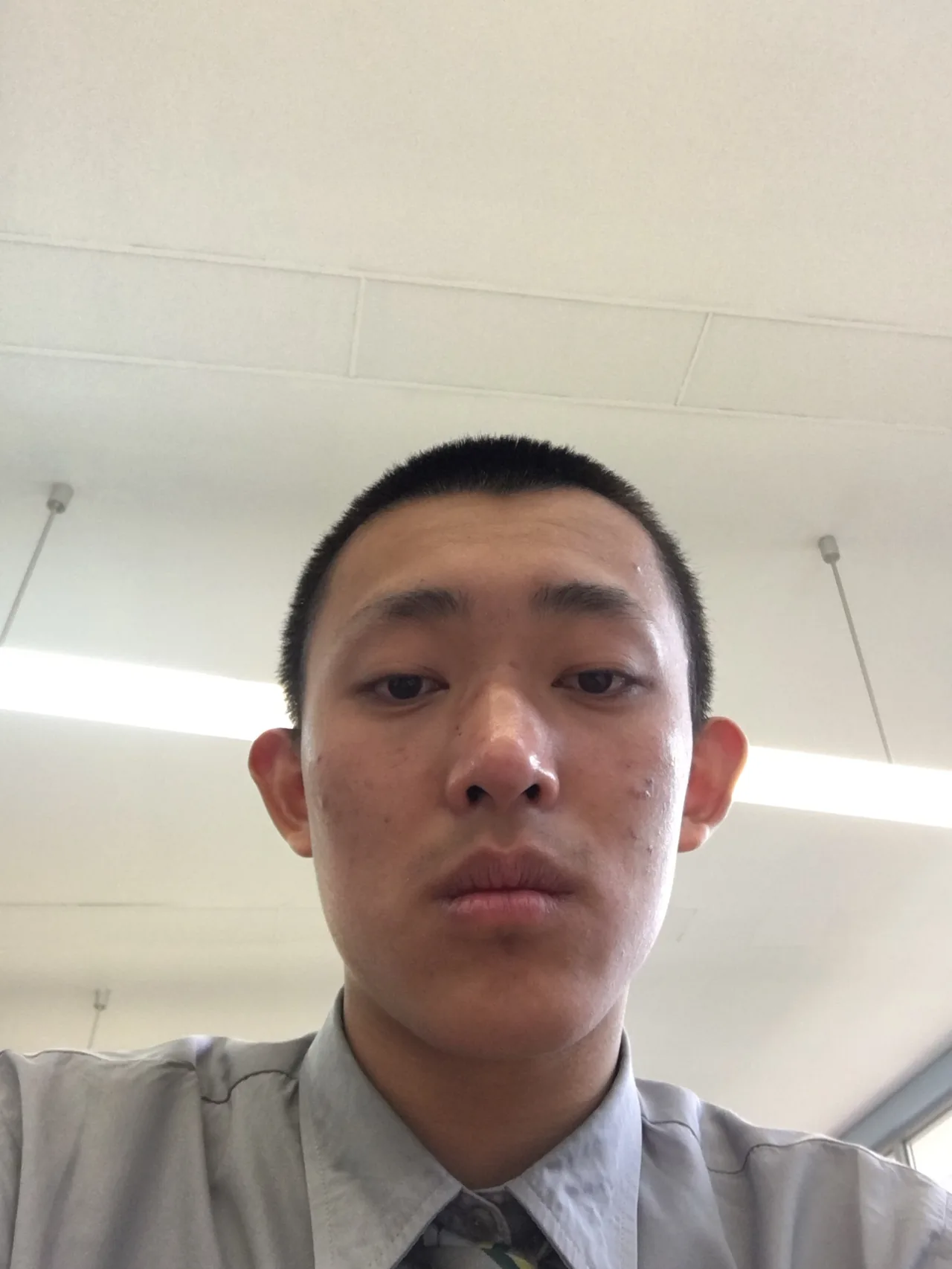
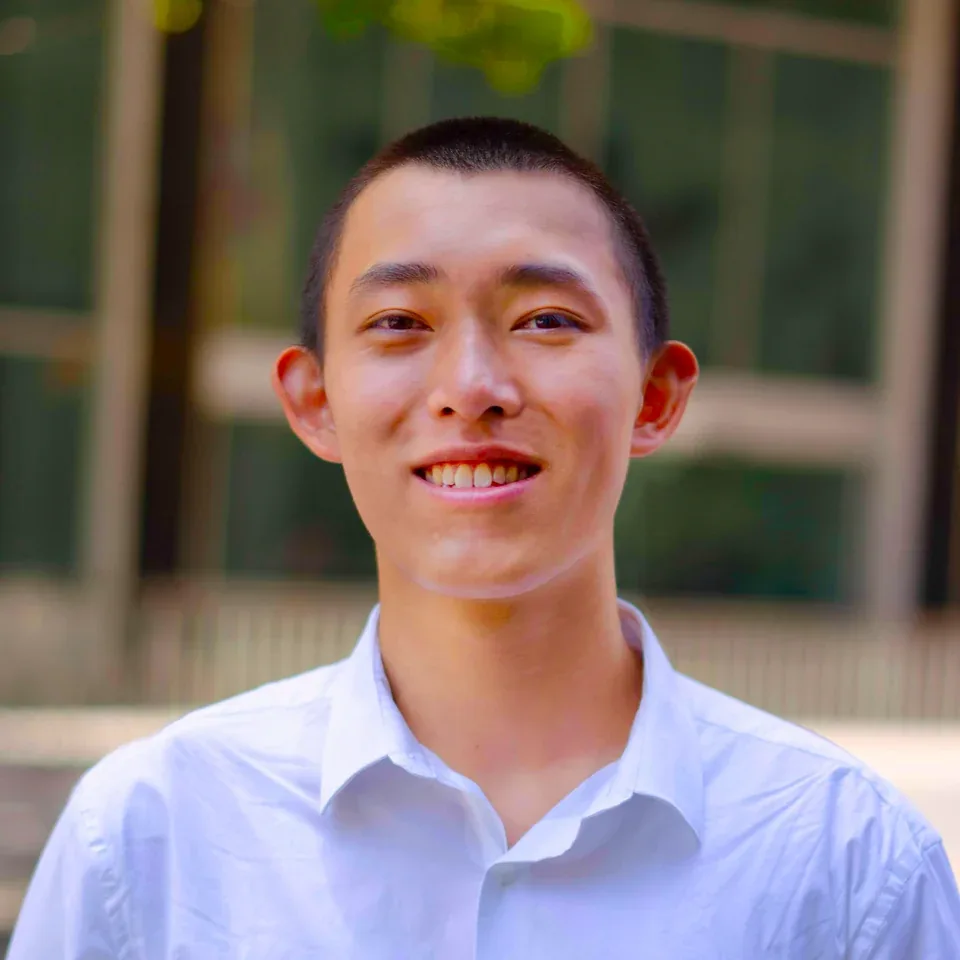
Bob’s Year 10 selfie in his school uniform
50th in
James Ruse Science
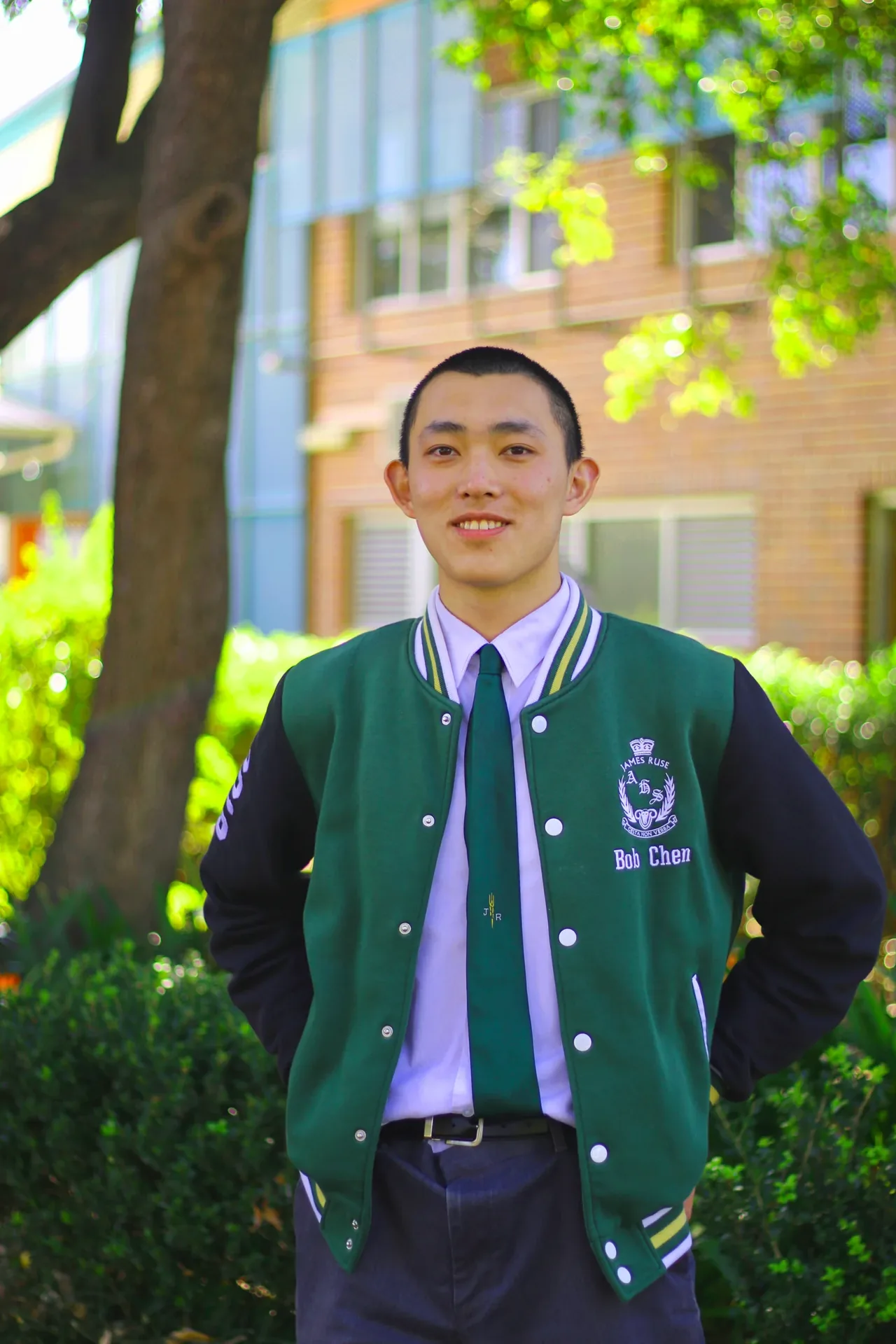
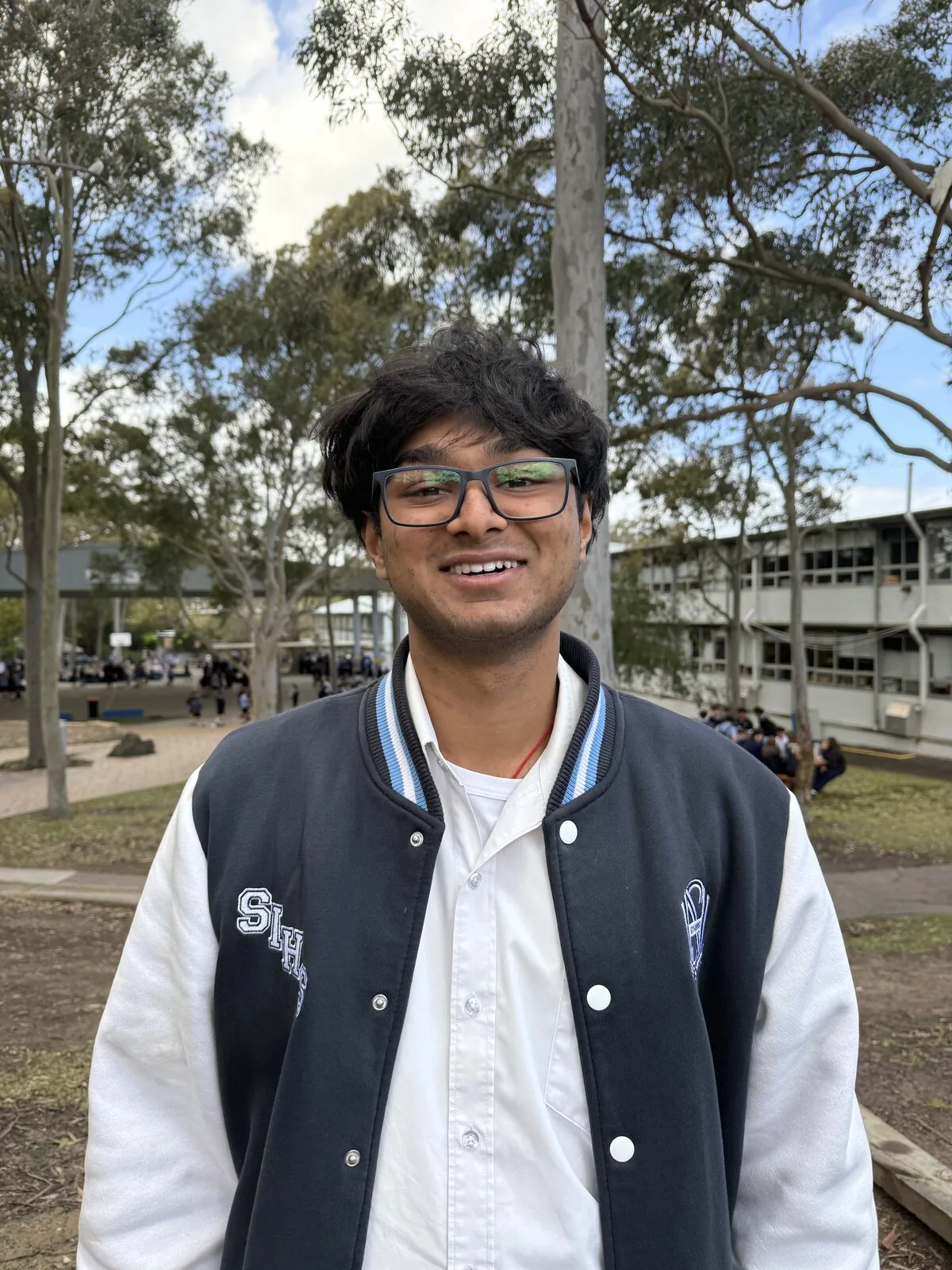
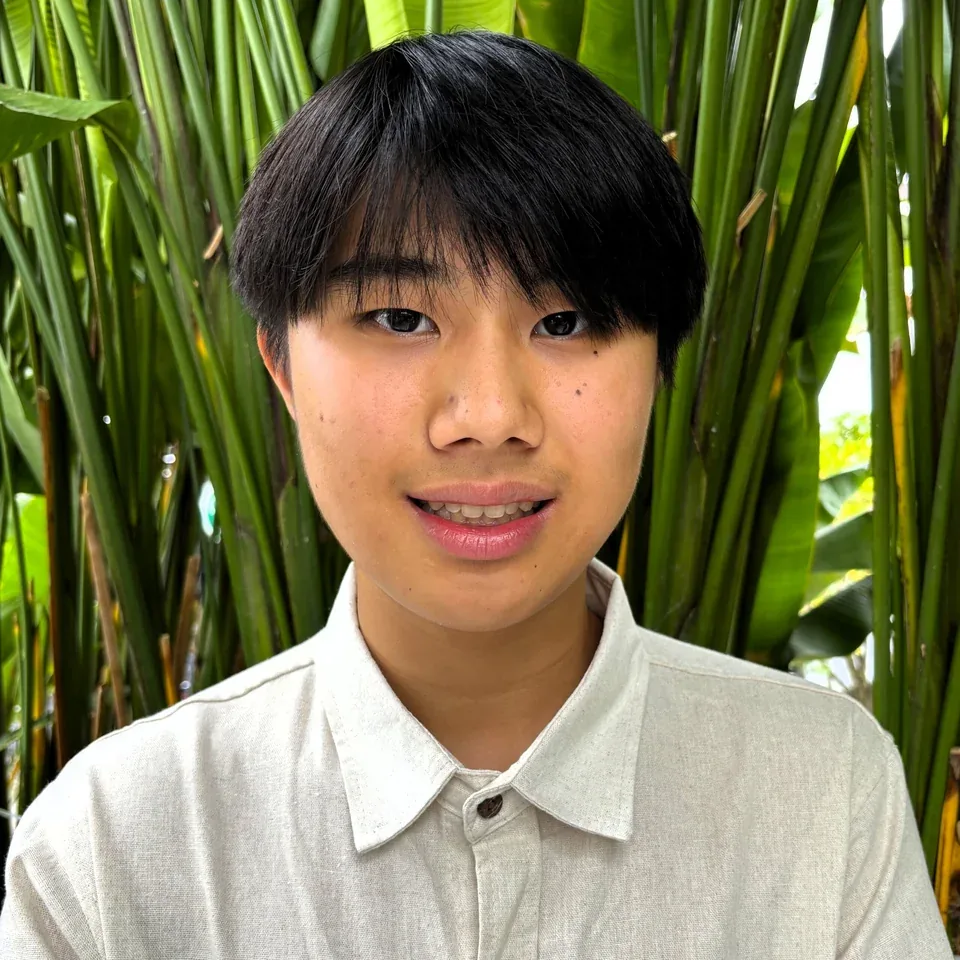
Bob in Year 12 wearing his James Ruse school jacket
1st in
Ruse Physics

Physics state rank99.85 ATARUSYD Med

Physics, Chemistry & Maths
HSC tutoring.

Watch 10 min demo

Physics student success

Full storyFull story
Full storyView results

The story behind tutorgum.

Before topping James Ruse Physics, I didn’t even want to tell my mum my marks.

Bob’s Year 10 selfie in his school uniform
50th in
James Ruse Science
Bob in Year 12 wearing his James Ruse school jacket
1st in
Ruse Physics

Physics state rank99.85 ATARUSYD Med

Skip story

But before I topped James Ruse Physics,I didn’t even want to tell my mum my marks.

But before I topped James Ruse Physics,
I didn’t even want to tell my mum my marks.

This was me in Year 10.

Ouch.

But there was something I was even worse at than taking selfies.

Science.

Cause, I hadn’t been doing so well.

Fuck.
50th in the cohort.

I hated science.

I studied. I memorised. I practised.

Yet I still used the wrong formulas.
I had to guess in exams.

I could never crack the top ranks or get 90%+.

I had lost control.

I didn’t want to tell my mum my marks.

So I knew something had to change.

I went on to achieve

  1. 1st in Ruse Physics.
  2. Physics state rank.
  3. 99.85 ATAR.
  4. USYD Med.
1.Better explanations

Explained intuitively and from scratch.

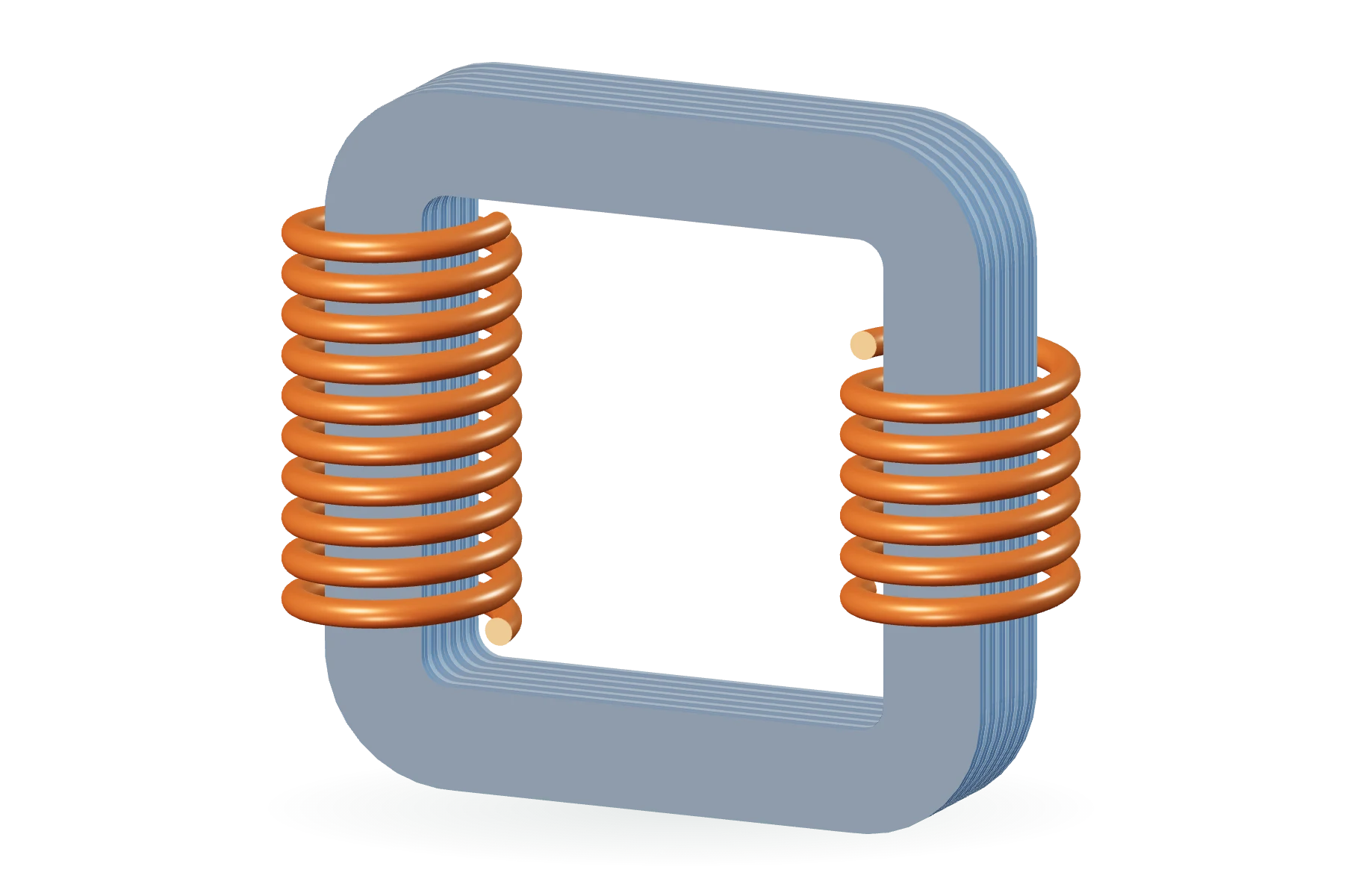
Two copper coils around a layered iron core. A changing current in the first coil creates a changing magnetic field, inducing a voltage in the second.

We all learn about transformers. But what if you could see why every component is the way it is?

First, we’re gonna strip it to the basics — just two coils of wire.

A current through a wire creates a magnetic field around it.

If we wind that wire around, we get a solenoid, which produces a magnetic field.

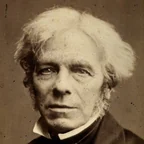
The left coil’s changing magnetic field induces a voltage in the right. That’s Faraday’s law.Photograph of Michael Faraday

Wireless chargers use this air-core setup. But we can make it even more efficient!

We add a soft iron core. Recall this boosts the magnetic field in the LHS solenoid.

The ingenious part is when we extend it into the RHS coil. This way, we bring way more of the magnetic field into the RHS coil, increasing the change in flux.

Close the iron loop to give the magnetic field a return path.

Use insulated iron sheets to reduce eddy currents and heating. That’s our full transformer!

2.Exam-style homework

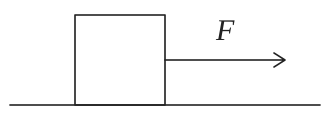
You know how in school
you learn

A block on level ground with a single horizontal force F pushing it to the right.F

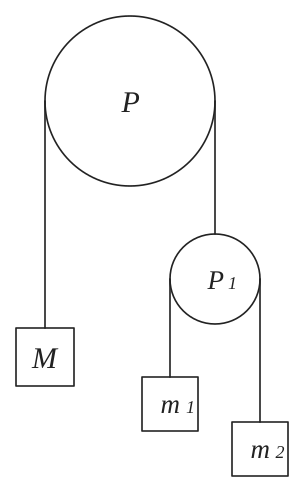
But then, in the exam,
you get
But then, in the exam, you get

Three masses connected by two pulleys: mass M hangs from the large pulley P, which supports a smaller pulley P₁ carrying masses m₁ and m₂.PP1Mm1m2

What if you got questions like this in your homework every week?

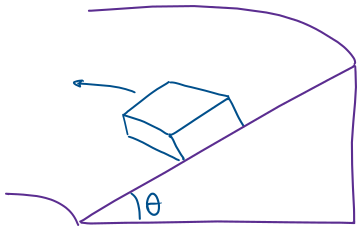
Year 12 Physics · Banked tracks

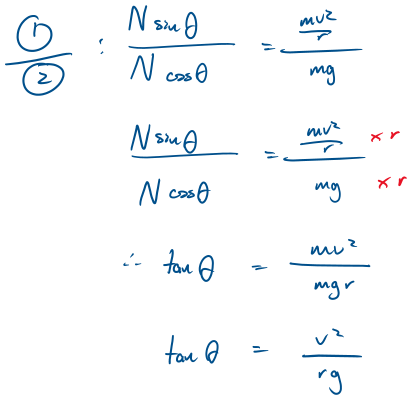
A curve of radius 78 m is banked at 10 degrees. The coefficient of friction is 0.1

  1. What is the ideal speed to drive at? (where friction does not need to be used)
  2. What is the minimum speed for this turn?
  3. Consider now the coefficient of friction is now 0.3. What range of speeds can the care make the curve? Interpret why your speed is negative

And every question had step-by-step worked solutions.

Expand allShow less

a) What is the ideal speed to drive at? (where friction does not need to be used)

ANSWER

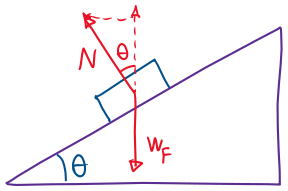
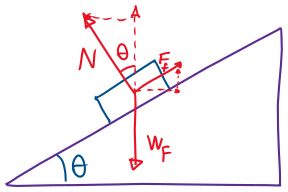
Step 1: Force diagram
Step 2: Force analysis

Considering the x – there is a net force! The horizontal part of tension must be the centripetal force!

Considering the y – there is no net force. Thus the vertical part of tension must balance the weight force

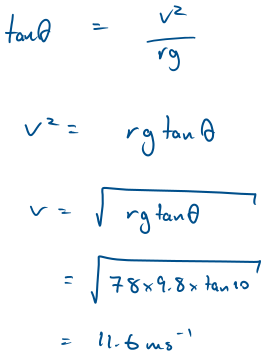
Step 3: Set up equation
Step 4: Plug and chug

b) What is the minimum speed for this turn?

ANSWER

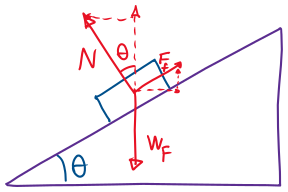
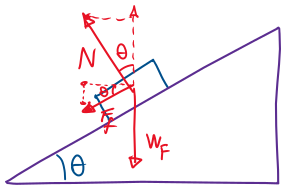
Step 1: Draw force diagram

The force of friction must point up the slope. When the car goes really slow, the car will slip towards the centre.

Step 2: Write out force equations

Vertically:

Ncos⁡θ+Ffsin⁡θ=Wf(1)N\cos \theta +{F}_{f}\sin \theta ={W}_{f}\quad (1)

Horizontally:

FC=Nsin⁡θ−Ffcos⁡θ(2){F}_{C}=N\sin \theta -{F}_{f}\cos \theta \quad (2)

If we transform them:

FC=−Ffcos⁡θ+Nsin⁡θ(2)′{F}_{C}=-{F}_{f}\cos \theta +N\sin \theta \quad {(2)}^{'}
Wf=Ff+sin⁡θ+Ncos⁡θ(1)′{W}_{f}={F}_{f}+\sin \theta +N\cos \theta \quad {(1)}^{'}
Step 3: Maths
(2)′(1)′FCWf=−Ffcos⁡θ+Nsin⁡θFf+sin⁡θ+Ncos⁡θ\frac{{(2)}^{'}}{{(1)}^{'}} \frac{{F}_{C}}{{W}_{f}}=\frac{-{F}_{f}\cos \theta +N\sin \theta }{{F}_{f}+\sin \theta +N\cos \theta }
mv2rmg=−μNcos⁡θ+Nsin⁡θμN+sin⁡θ+Ncos⁡θ\frac{\frac{m{v}^{2}}{r}}{mg}=\frac{-\mu N\cos \theta +N\sin \theta }{\mu N+\sin \theta +N\cos \theta }
v2rg=−μcos⁡θ+sin⁡θμsin⁡θ+cos⁡θ\frac{\frac{{v}^{2}}{r}}{g}=\frac{-\mu \cos \theta +\sin \theta }{\mu \sin \theta +\cos \theta }
v2=−0.1cos⁡10+sin⁡100.1sin⁡10+cos⁡10×78×9.8{v}^{2}=\frac{-0.1\cos 10+\sin 10}{0.1\sin 10+\cos 10}\times 78\times 9.8
v=7.6ms−1v=7.6 {ms}^{-1}

c) Consider now the coefficient of friction is now 0.3. What range of speeds can the care make the curve? Interpret why your speed is negative

ANSWER

If you do the calculations, you’ll see that the min speed is negative!

What does this mean!?

It means there is no minimum speed. At any speed the friction will prevent you from sliding down. You could be going at 0m/s and you’ll be able to stay on the curve (there’s just a lot of friction!). it’s like how you can stand on a slanted hill surface.

Step 1: Force equations

Vertically:

Ncos⁡θ+Ffsin⁡θ=Wf(1)N\cos \theta +{F}_{f}\sin \theta ={W}_{f}\quad (1)

Horizontally:

Fc=Nsin⁡θ−Ffcos⁡θ(2){F}_{c}=N\sin \theta -{F}_{f}\cos \theta \quad (2)

At maximum friction:

Ff=μN{F}_{f}=\mu N
Step 2: Maths

Dividing (2) by (1):

FcWf=−μNcos⁡θ+Nsin⁡θμNsin⁡θ+Ncos⁡θ\frac{{F}_{c}}{{W}_{f}}=\frac{-\mu N\cos \theta +N\sin \theta }{\mu N\sin \theta +N\cos \theta }
mv2/rmg=−μcos⁡θ+sin⁡θμsin⁡θ+cos⁡θ\frac{m{v}^{2}/r}{mg}=\frac{-\mu \cos \theta +\sin \theta }{\mu \sin \theta +\cos \theta }
v2rg=−0.3cos⁡10+sin⁡100.3sin⁡10+cos⁡10\frac{{v}^{2}}{rg}=\frac{-0.3\cos 10+\sin 10}{0.3\sin 10+\cos 10}
v2=−89.8{v}^{2}=-89.8

Since v2{v}^{2} cannot be negative, there is no minimum speed.

Step 3: Maximum speed

Friction now acts down the slope, as the car tends to slide up the slope.

Vertically:

Ncos⁡θ−Ffsin⁡θ=Wf(1)N\cos \theta -{F}_{f}\sin \theta ={W}_{f}\quad (1)

Horizontally:

Fc=Nsin⁡θ+Ffcos⁡θ(2){F}_{c}=N\sin \theta +{F}_{f}\cos \theta \quad (2)

Using Ff=μN{F}_{f}=\mu N, divide (2) by (1):

FcWf=μNcos⁡θ+Nsin⁡θNcos⁡θ−μNsin⁡θ\frac{{F}_{c}}{{W}_{f}}=\frac{\mu N\cos \theta +N\sin \theta }{N\cos \theta -\mu N\sin \theta }
v2rg=μcos⁡θ+sin⁡θcos⁡θ−μsin⁡θ\frac{{v}^{2}}{rg}=\frac{\mu \cos \theta +\sin \theta }{\cos \theta -\mu \sin \theta }

Substitute:

v2=78(9.8)(0.3cos⁡10+sin⁡10cos⁡10−0.3sin⁡10){v}^{2}=78(9.8)(\frac{0.3\cos 10+\sin 10}{\cos 10-0.3\sin 10})
v=384.4v=\sqrt{384.4}
v=19.6m/sv=19.6 m/s

Hence the range of speeds is

0≤v≤19.6m/s0\leq v\leq 19.6 m/s

And don’t worry,
there’s plenty more where that came from.

3.1-to-1 support

Ask questions any time - inclass, afterclass or between classes! Contact your tutor anytime.

We don’t offer separate 1–1 tutoring.

Bob Chen
7thNSW Physics state rank
Jerome Shin
100%Maths Ext 1 exam · James Ruse

Wait, so what does a week at Tutorgum actually look like?

The lesson ends. The learning keeps going.

Mon
Tue
Wed
Thu
Fri
Sat
Sun
Class7–9pm
HomeworkTry exam-style questions with worked solutions to help you through.
Tutor supportAsk when a question comes up. You do not have to wait for the next class.
Find your class

Monday 7–9pm

01 / 06
  1. Quiz

  2. Review

  3. Theory

  4. Questions

  5. Theory

  6. Questions

Show school termsHide school terms
Classes continue through school holidaysChristmas / New Year: 2-week break
Module 5: Advanced MechanicsProjectiles, circular motion and gravity — weekly outline

Weeks start at 1 for each module.

  1. Week 1
    Projectile motion

    Revise kinematics and vector resolution, then analyse projectiles launched at an angle.

  2. Week 2
    Harder projectile problems

    Build a systematic approach to horizontal and vertical motion, including hidden information and unknowns.

  3. Week 3
    Circular motion

    Connect period, speed and centripetal acceleration and distinguish centripetal and centrifugal descriptions.

  4. Week 4
    Forces in circular motion

    Use friction, tension and banked-track examples to identify the inward force.

  5. Week 5
    Non-uniform circular motion

    Analyse banked tracks with friction and explore the changing forces in vertical circular motion.

  6. Week 6
    Circular motion and energy

    Apply radial and tangential reasoning and energy ideas to roller-coaster and circular-motion questions.

  7. Week 7
    Orbits and Kepler's laws

    Combine gravitation and centripetal force to find orbital speed and interpret Kepler's laws.

  8. Week 8
    Gravitational potential energy

    Use an infinity reference for gravitational potential energy and compare it with near-Earth approximations.

  9. Week 9
    Orbital transfers and mechanics review

    Explore Newton's cannon and orbital transfers, then revisit challenging projectile and circular-motion questions.

  10. Week 10
    Advanced Mechanics exam practice

    Work through the latest Module 5 exam and consolidate the module's problem-solving techniques.

Christmas / New Year break2 weeks off
Module 6: ElectromagnetismFields, motors and induction — weekly outlineSummer holidays — classes continue in holidays

Weeks start at 1 for each module.

  1. Summer holidays — classes continue in holidays
  2. Week 1
    Fields and the Lorentz force

    Review electric and magnetic fields and introduce forces on moving charges.

  3. Week 2
    Charged particles in fields

    Apply the Lorentz force to particle paths and harder electric and magnetic field questions.

  4. Week 3
    The motor effect

    Explain forces on current-carrying conductors and interactions between parallel wires.

  5. Week 4
    Magnetic flux and Faraday's law

    Define magnetic flux and use changing flux to explain induced electromotive force.

  6. Week 5
    Lenz's law and eddy currents

    Determine induced-current directions and explain applications of eddy currents.

  7. Week 6
    Transformers

    Connect induction to transformer operation, practical limitations and induction applications.

  8. Week 7
    DC motors

    Revise torque and explain how coils, brushes and commutators make a DC motor work.

  9. Week 8
    Motor applications and back EMF

    Compare motor arrangements and explain the role of back EMF in operation.

  10. Week 9
    Generators and back torque

    Explain generator operation and the opposing torque associated with electromagnetic induction.

  11. Week 10
    AC induction motors and braking

    Explore induction motors, three-phase arrangements and electromagnetic braking.

  12. Week 11
    Electromagnetism exam practice

    Practise exam-style electromagnetic questions and review the module's key ideas.

Module 7: The Nature of LightWaves, photons and relativity — weekly outlineTerm 2 holidays — classes continue in holidays

Weeks start at 1 for each module.

  1. Week 1
    Maxwell, Hertz and light

    Trace the development and verification of the electromagnetic model of light.

  2. Week 2
    Measuring light and reading spectra

    Compare measurements of the speed of light and introduce spectra as evidence about stars.

  3. Week 3
    Wave and particle models

    Compare Newton and Huygens, then examine Young's double-slit and Poisson-spot evidence.

  4. Term 2 holidays — classes continue in holidays
  5. Week 4
    Diffraction and polarisation

    Apply diffraction-grating relationships and Malus' law and compare evidence for light models.

  6. Week 5
    Blackbody radiation

    Explore the ultraviolet catastrophe and how blackbody radiation challenged classical physics.

  7. Week 6
    The photoelectric effect

    Compare classical predictions with observations and use the photon model to explain the effect.

  8. Week 7
    Special relativity

    Introduce time dilation, length contraction and simultaneity through thought experiments and paradoxes.

  9. Week 8
    Evidence for relativity

    Examine experiments supporting relativity's postulates, time dilation and length contraction.

  10. Week 9
    Relativistic momentum and energy

    Apply relativistic momentum, mass-energy relationships and velocity addition.

  11. Week 10
    Explaining changes in light models

    Construct extended responses connecting experimental evidence to the development of light models.

Module 8: From the Universe to the AtomStars, atoms and nuclei — weekly outlineTerm 3 holidays — classes continue in holidays

Weeks start at 1 for each module.

  1. Week 1
    The Big Bang and expanding universe

    Explore the Big Bang model, expanding space and the formation of cosmic structures.

  2. Week 2
    Stars and nucleosynthesis

    Connect stellar spectra, the Hertzsprung-Russell diagram and nuclear reactions in stars.

  3. Week 3
    Discovering the electron

    Compare cathode-ray experiments, charge-to-mass measurements and Millikan's oil-drop experiment.

  4. Week 4
    The nucleus and neutron

    Use scattering evidence to explain Rutherford's model and examine Chadwick's neutron discovery.

  5. Week 5
    Hydrogen spectra and Bohr's model

    Connect hydrogen emission lines and the Rydberg relationship to Bohr's atomic model.

  6. Week 6
    Matter waves and quantum models

    Explore the limits of Bohr's model, de Broglie's proposal and the development of quantum descriptions.

  7. Term 3 holidays — classes continue in holidays
  8. Week 7
    Radioactivity and half-life

    Compare radiation types, calculate radioactive decay and examine nuclear instability.

  9. Week 8
    Fission, fusion and binding energy

    Connect binding energy to nuclear reactions, reactors and energy release.

  10. Week 9
    The Standard Model

    Examine evidence for subatomic structure and organise fundamental particles using the Standard Model.

  11. Week 10
    Particle accelerators

    Explain how accelerators probe matter and contribute to developing particle models.

Trials preparationReview the topics and practise trial questions — weekly outline

Weeks start at 1 for each module.

  1. Week 1
    Advanced Mechanics revision

    Revisit Module 5 theory and practise questions chosen around areas needing revision.

  2. Week 2
    Electromagnetism revision

    Review forces on charges, helical motion and induction through challenging Module 6 questions.

  3. Week 3
    The Nature of Light revision

    Practise questions on light measurements, wave evidence, photons and relativity.

  4. Week 4
    Universe to Atom revision

    Review cosmology, stellar reactions, atomic models and quantum evidence.

  5. Week 5
    Trial mock paper 1

    Work through mixed questions on mechanics, motors, transformers and scientific reasoning.

  6. Week 6
    Trial mock paper 2

    Practise mixed questions involving induction, photoelectric observations, light models and relativity.

  7. Week 7
    Trial mock paper 3

    Work through the third mock-paper stage and revisit the mechanics questions selected in the notes.

HSC exam preparationTimed papers, difficult questions and exam technique — weekly outlineTerm 4 holidays — classes continue in holidays

Weeks start at 1 for each module.

  1. Week 1
    Advanced Mechanics exam consolidation

    Practise circular motion, banked tracks and gravitational-energy questions.

  2. Term 4 holidays — classes continue in holidays
  3. Week 2
    Induction and back-EMF practice

    Develop explanations and solve harder induction and motor questions.

  4. Week 3
    Light and photon exam consolidation

    Review Planck's proposal and the photoelectric effect, with emphasis on conceptual responses.

  5. Week 4
    Mass-defect practice

    Explain mass defect and practise the related calculations.

  6. Week 5
    Relativity and response review

    Revisit proper time and proper length and review selected written responses.

  7. Week 6
    Mixed exam-question review

    Work through the selected exam questions and refine your problem-solving approach.

  8. Week 7
    Physics exam technique

    Practise flux, binding-energy and radiation questions alongside time management and response planning.

  9. Week 8
    Challenging HSC questions

    Combine mechanics, induction, relativity, spectra and scientific skills in harder exam problems.

  10. Week 9
    Final HSC paper practice

    Work through the final HSC practice paper and review questions needing further attention.

A weekly class.
Support around it.

Choose your year, find a time and try a lesson.

Year 12 Physics

$60/ hour

$120 per week

  • Includes a two-hour class
  • Homework with step-by-step solutions for every question
  • Help with any extra questions you have
  • Exam and depth study preparation
Find a Year 12 class

Currently listed classes are below. Contact us to confirm a time for the incoming accelerated or normal intake.

Class timetable

Find your class.

Why not try a class - it's risk free!

The first lesson is only charged if you want to continue, otherwise it's totally free!

FAQ

Do you offer online Physics tutoring for students in Sydney and elsewhere?

Yes. Our HSC Physics tutoring takes place online over Zoom, so students can join from Sydney, regional NSW or elsewhere in Australia. Year 11 and Year 12 classes include exam-style homework, worked solutions and 1-to-1 tutor support. The course follows the NSW HSC; contact us to check suitability if you study a different curriculum.

How does a Physics tutor help me improve my exam answers?

There's 2 important prongs: 1. Learning the content well and 2. Practice. First, we teach you why the physics works so you can apply it when an exam question looks different from the ones you’ve seen before.

Then you practise HSC-style questions in class. We also review real student responses together, especially in Trial exam and HSC preparation classes.

Can I join after the course has started?

Tell us your school year, the topics you have covered and where you feel stuck. We’ll help you choose a suitable class and discuss what you would need to catch up before you enrol.

What if my school teaches the topics in a different order?

Our course follows a set sequence. Bring your school’s assessment schedule so we can compare it with the class plan and discuss support for the topics you need sooner.

What if I am nervous about asking questions?

You can ask during class or speak with your tutor privately. The 1-to-1 support is there to help you work through a question or an idea that has not clicked yet.

What happens when I book a trial?

Send us your year, subject and preferred class. We’ll help you find a suitable lesson. The first lesson is only charged if you want to continue, otherwise it's totally free!

Group lessons don't work for my child. They're too shy to ask questions.

I was always that shy boy. I was scared to ask questions - I was scared of what other people would think.

  • Students can ask questions 1-1 after class, or between classes via email/text.
  • I ask every student questions during class – so everyone is forced to interact.
  • I monitor every student to see if they’re falling behind.

If you definitely need a 1-1 setting, then you should hire someone else.

But, is the setting more important to you, than your child getting an expert? There’s a lot of tutors out there. But how many of them have topped NSW? Not all of them know chemical equilibrium and electromagnetism like I do. Or how to explain it to get the "Aha!" moment. Or why students lose marks. Or how to fix it. And that means they won't produce results, like helping Kirsten Chu, 2022, move from 56% to 91%.

Can my child catchup to the group pace?

No one wants to be in an environment where they're far behind everyone else. To help you judge if it's suitable, the average student we get comes in with marks at, or a bit below average. We get a mix of selective (NSB, NSG, Ruse etc), private (Scots, St Patricks, Meriden etc) and comprehensive schools (Castle Hill, Carlingford HS etc). We help them catchup by answering questions after class and providing support material for previous topics.

In class when we go through a new topic, we will always explain it from scratch - so even if you have missed out on previous concepts, it won't stop you from getting the new ones.

But what if my child has questions?

Our group is run differently to most tutors. I am willing to spend 1-1 time with you. If you have questions – you can ask me 1-1 after class! And throughout the week! I’ll spend an hour with you if you need it.

How do your classes work?

We have one 2 hour session per week. It's online, via Zoom.

What do you do in class?

We start the lesson with a 10 min quiz. Then we go through a new concept and then do a few questions to solidfy it. Then we repeat this for the whole lesson. When exam time comes, we do revision lessons where a practice exam is sent before class, and the hard questions students request are reviewed in class.

How does payment work?

We accept payment via Bank Transfer. We typically bill termly. If you wish to discontinue, all unused lessons will be refunded, in full, to you.

What if I miss a lesson?

We highly recommend not to skip lessons for exams - if you are pressed for time, it is best if you skip the homework but come anyway. If you are away for a lesson, all materials will be provided and a recording will be made for you, however, the lesson will not be refunded.

Do you have other class times?
Do you have classes in the holidays?

Yes - classes run as per usual. It's as if the holidays do not exist. But we do not run intensive lessons in the holidays as they are ineffective for students.

Group size

It varies, but often hovers around 5

What do students need to join online?

Enthusiasm, pen, and preferably a dedicated book. All other resources will be sent.

How do you prepare students for School Exams?

The major reason why students do not do well in their exams is because they lack knowledge of the core concepts. After doing content with us, most students do not experience this anymore. From this strong foundation, we do weekly exam style problems in the homework - meaning weekly practice for exams.

Just before exams, we will also give access to our private collection of school past papers which is the best practice. We will also go through exam technique in class before exams.

When will you finish the syllabus?

In the accelerated classes, we usually finish the entire syllabus 1 term before trials (final Year 12 exams in Term 3 Week 2). This gives us ~7 weeks of revision before trials. We will then have ~10 weeks of revision after Trials for the HSC. We will revise each module with a weekly exam on that module, and then do mock papers.

In School Paced classes, we match school - so we have around 6 weeks of revision for HSC.

What order do you cover the syllabus content in?

Module 1, 2, 3, 4, 5, 6, 7, 8.

But that order isn't what my school is doing!

Some schools do decide to do it out of order. In my experience, this is ok because the same content is covered by the time you sit the exam. The most important factor is that the student learns something - even if it's not synchronised with school.

What is your typical student like?

Our students typically come with marks at, or a bit below average. We get a mix of selective (NSB, NSG, Ruse etc), private (Scots, St Patricks, Meriden etc) and comprehensive schools (Castle Hill, Carlingford HS etc).

What does a good candidate for your program look like?

Your improvement does not depend on how smart you are. The most important quality that determines success in the program is your willingness to work. Students that have shown dramatic improvements like Jade Yang and Kirsten Chu put in 10h+ per week into Physics and Chemistry. We make it easy for you - as long as you do all the homework (exam practice) and come to every class, you will improve.

The question is - will you do it?

Do you offer online Physics and Chemistry tutoring?

Yes. Our online Physics tutoring and Chemistry tutoring are small-group classes for Year 11 and Year 12 students studying the NSW HSC. Physics is sometimes shortened to ‘phys’, but the course is the same HSC Physics subject. Lessons take place on Zoom, with exam-style homework, worked solutions and 1-to-1 tutor support between classes.

Explore Physics tutoring or Chemistry tutoring to see the courses, or check prices and class times.

Can I join from Sydney, regional NSW or outside NSW?

Yes. Classes are online, so you can join from Sydney, Newcastle, Wollongong, regional NSW or elsewhere in Australia. You do not need to travel to a tutoring centre.

The Physics and Chemistry courses are designed for the NSW HSC. If you study another state's syllabus or a different curriculum, contact us with your year and topics so we can discuss whether the course is suitable. Online access does not mean every curriculum is covered.

Still have a question?

Call 0490 496 078