Tutorgum
Try a Class

HSC Maths Extension 1 tutoring.

Small-group online classes.
Exam-style homework, with step by step solutions.
1-to-1 tutor support.

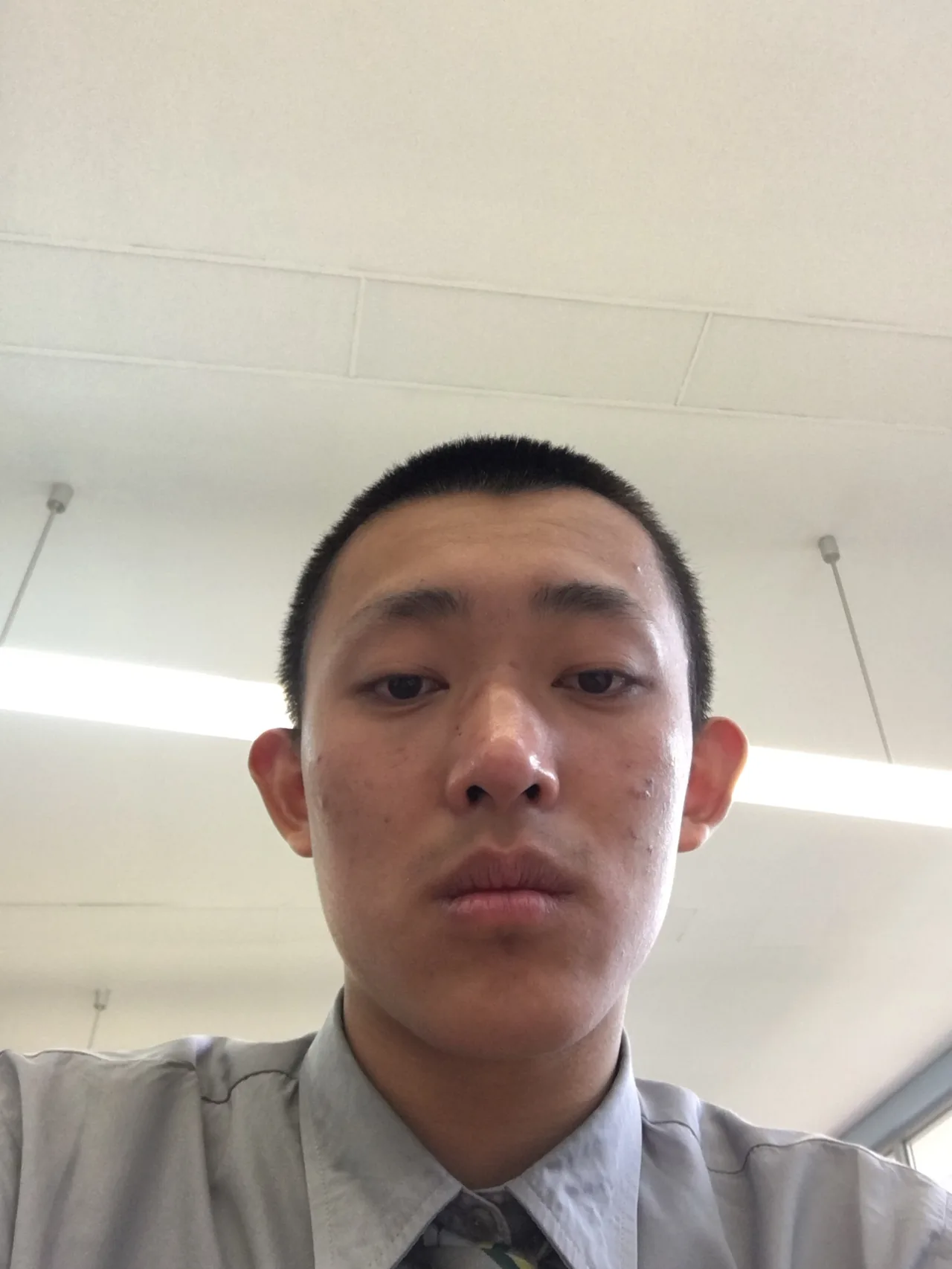
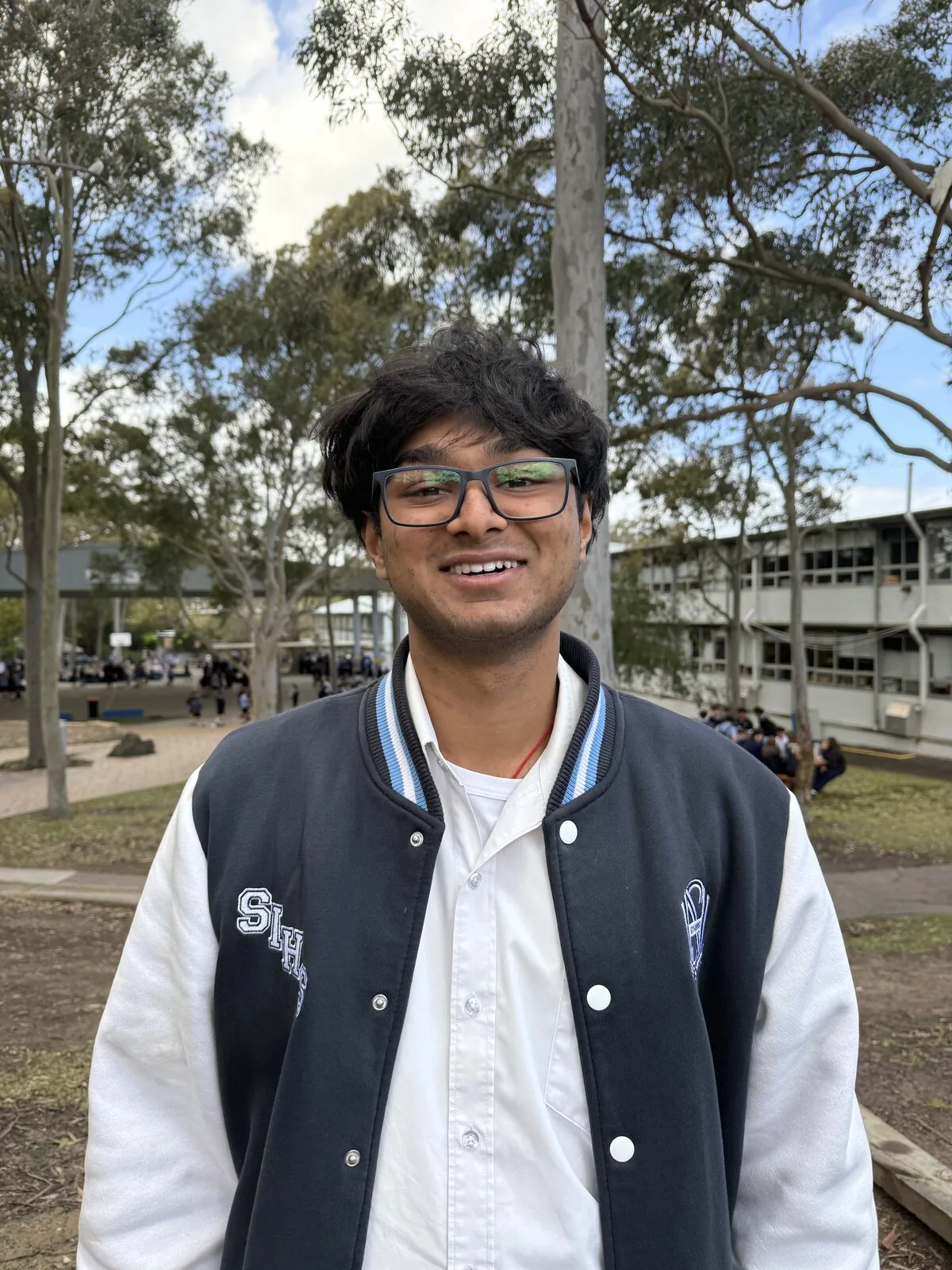
Bob’s Year 10 selfie in his school uniform
50th in
James Ruse Science
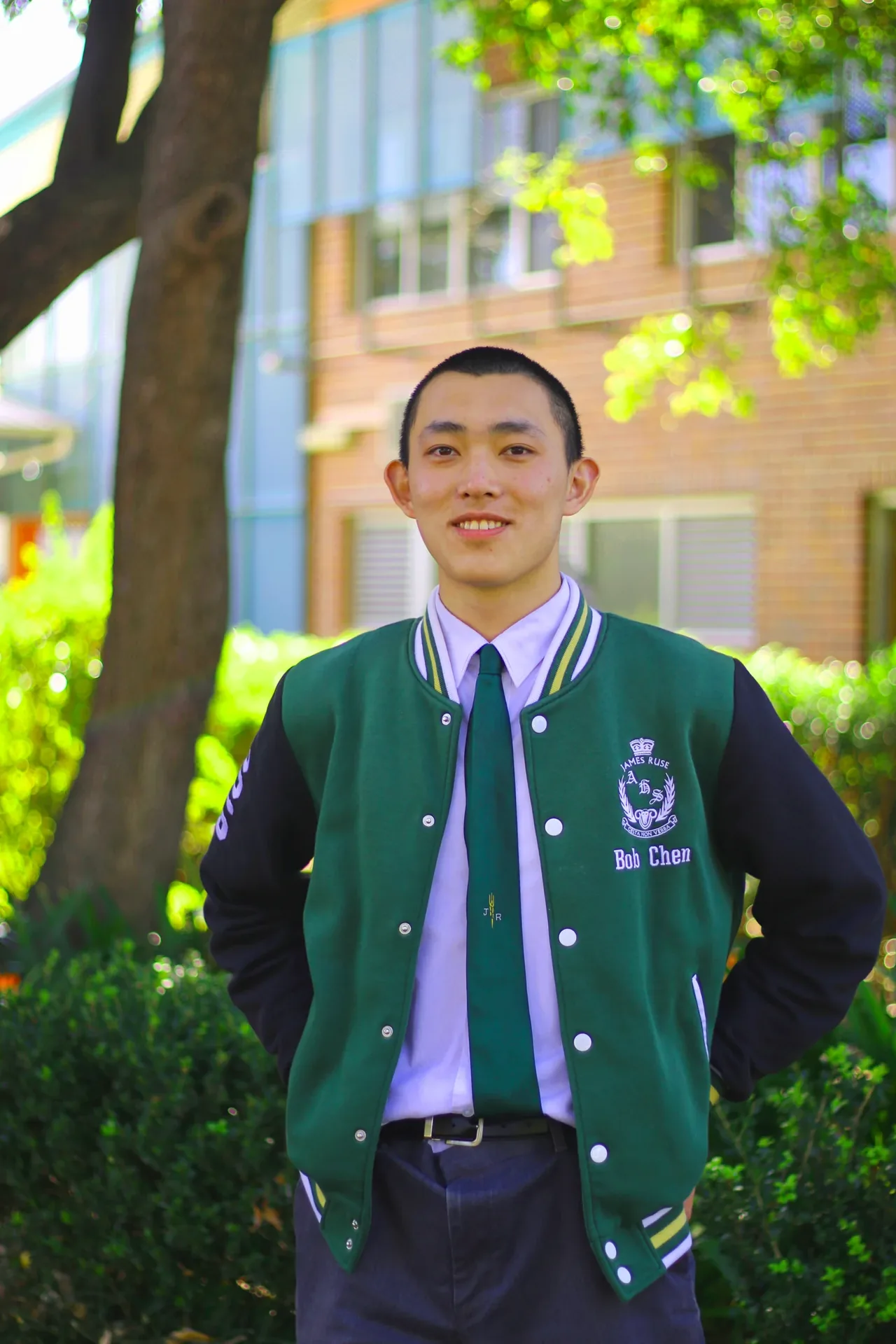
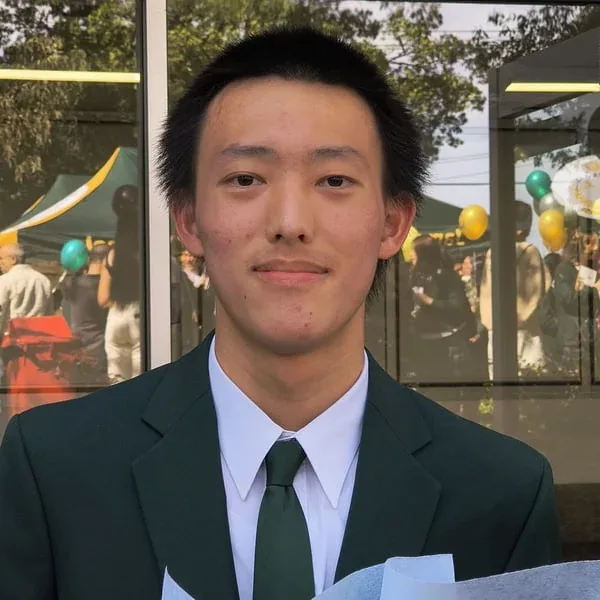
Bob in Year 12 wearing his James Ruse school jacket
1st in
Ruse Physics

Physics state rank99.85 ATARUSYD Med

Physics, Chemistry & Maths
HSC tutoring.

Watch 10 min demo

Student success at Tutorgum

Full storyFull story
View results

The story behind tutorgum.

Before topping James Ruse Physics, I didn’t even want to tell my mum my marks.

Bob’s Year 10 selfie in his school uniform
50th in
James Ruse Science
Bob in Year 12 wearing his James Ruse school jacket
1st in
Ruse Physics

Physics state rank99.85 ATARUSYD Med

Skip story

But before I topped James Ruse Physics,I didn’t even want to tell my mum my marks.

But before I topped James Ruse Physics,
I didn’t even want to tell my mum my marks.

This was me in Year 10.

Ouch.

But there was something I was even worse at than taking selfies.

Science.

Cause, I hadn’t been doing so well.

Fuck.
50th in the cohort.

I hated science.

I studied. I memorised. I practised.

Yet I still used the wrong formulas.
I had to guess in exams.

I could never crack the top ranks or get 90%+.

I had lost control.

I didn’t want to tell my mum my marks.

So I knew something had to change.

I went on to achieve

  1. 1st in Ruse Physics.
  2. Physics state rank.
  3. 99.85 ATAR.
  4. USYD Med.
Turn a curve into a vase

We’re gonna turn this boring curve into a flower vase!

012340.511.522.5yr
f(y)=12+y28f(y)=\frac12+\frac{y^2}{8}

This is our vase. But how can we figure out its volume?

Look at one thin slice. The radius sweeps out a face of area πr². Multiply that area by the thickness Δy.

V=area×heightV=\textcolor{#8c19be}{\text{area}}\times\textcolor{#af4400}{\text{height}}

ΔV≈πr2×Δy\Delta V\approx \textcolor{#8c19be}{\pi r^2}\times \textcolor{#af4400}{\Delta y}

Look near the rim. The vase widens faster here, so a thick disc misses more. Watch the yellow gaps shrink as the discs get thinner.

V=area×heightV=\textcolor{#8c19be}{\text{area}}\times\textcolor{#af4400}{\text{height}}

ΔV≈πr2×Δy\Delta V\approx \textcolor{#8c19be}{\pi r^2}\times \textcolor{#af4400}{\Delta y}

To find the total volume, we’ll just sum each of the discs.

V=area×heightV=\textcolor{#8c19be}{\text{area}}\times\textcolor{#af4400}{\text{height}}

ΔV≈πr2×Δy\Delta V\approx \textcolor{#8c19be}{\pi r^2}\times \textcolor{#af4400}{\Delta y}

Vn=∑i=1nπri2 ΔyV_n=\sum\limits_{i=1}^{n}\textcolor{#8c19be}{\pi r_i^2}\,\textcolor{#af4400}{\Delta y}

To get the most perfect answer, we need there to be infinite discs, so we take the limit.

V=lim⁡n→∞(∑i=1nπri2 Δy)V=\lim_{n\to\infty}\left(\sum\limits_{i=1}^{n}\textcolor{#8c19be}{\pi r_i^2}\,\textcolor{#af4400}{\Delta y}\right)

This gives us an integral!

V=∫04 ⁣πf(y)2 dy\phantom{V}\displaystyle =\int_0^4 \! \textcolor{#8c19be}{\pi f(y)^2}\,\textcolor{#af4400}{dy}

V=103π15\phantom{V}=\frac{103\pi}{15}

2.Exam-style homework

You know how in school
you learn

sin⁡30∘=12\sin 30^\circ=\frac{1}{2}

But then, in the exam,
you get
But then, in the exam, you get

392=(usin⁡32∘)2+(u+14sin⁡58∘)2−2(usin⁡32∘)(u+14sin⁡58∘)cos⁡33∘\begin{aligned}392={}&\textcolor{#075b8d}{\left(\frac{u}{\sin32^\circ}\right)}^2+\textcolor{#733893}{\left(\frac{u+14}{\sin58^\circ}\right)}^2\\&-2\textcolor{#075b8d}{\left(\frac{u}{\sin32^\circ}\right)}\textcolor{#733893}{\left(\frac{u+14}{\sin58^\circ}\right)}\cos33^\circ\end{aligned}

What if you got questions like this in your homework every week?

Maths Extension 1 · Trigonometry

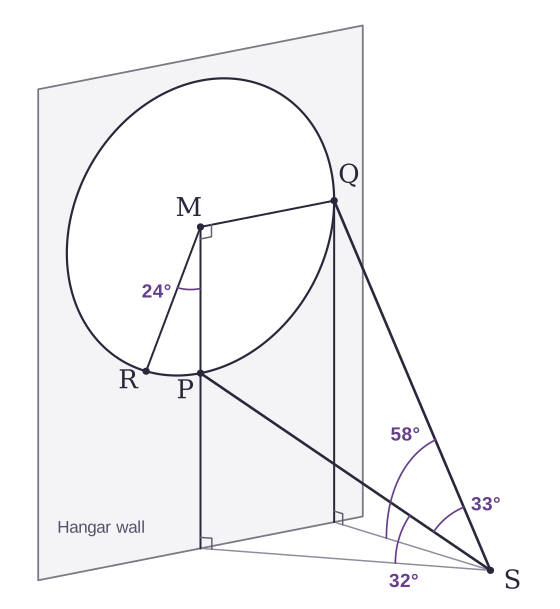
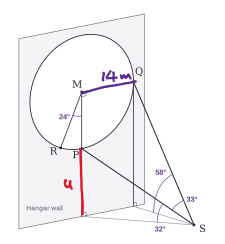
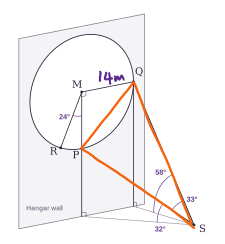
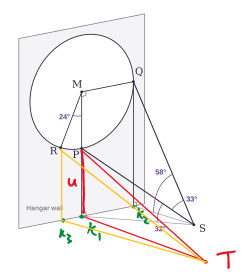
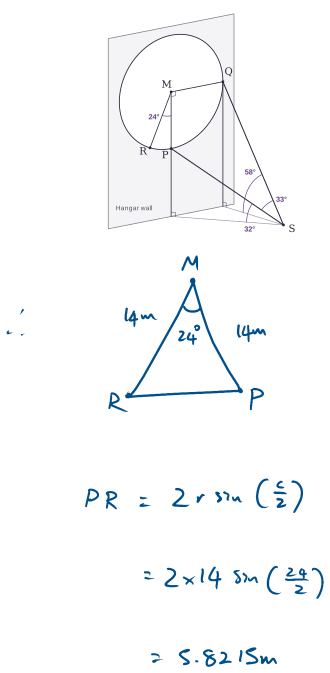
A circular calibration target of radius 14 m is mounted on a vertical hangar wall above level ground. Its centre is MM. Point PP is the lowest point on the circle. Point QQ lies directly to the right of MM at the same height. Point RR lies on the circle to the left of MPMP, with ∠PMR=24∘\angle PMR=24^\circ. A laser scanner at SS on the ground aims at PP and QQ at angles of elevation of 32∘32^\circ and 58∘58^\circ, respectively. The angle between the two beams is ∠PSQ=33∘\angle PSQ=33^\circ.

A circular target on a vertical wall with centre M and points P, Q and R. From S, the elevations to P and Q are 32 and 58 degrees. The beams are 33 degrees apart.
  1. Let uu be the height of PP above the ground, in metres.
    1. Express SPSP and SQSQ in terms of uu. (2 marks)
    2. Find uu, correct to two decimal places. (5 marks)
  2. A second scanner at TT on the same level ground aims at PP at an elevation of 28∘28^\circ. It then turns through 7∘7^\circ to aim at RR, so ∠PTR=7∘\angle PTR=7^\circ. Find both possible values of ∠PRT\angle PRT to the nearest degree. Use the unrounded value of uu. (4 marks)

And every question had step-by-step worked solutions.

Expand allShow less

(a)(i)Express SP and SQ in terms of u.\text{(a)(i)}\quad \text{Express } SP \text{ and } SQ \text{ in terms of }u.

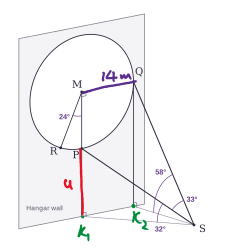
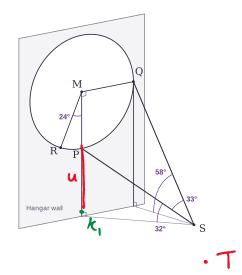
Step 1: Mark on diagram
The height of P is u and radius MQ is 14 metres.

Let the point vertically below PP be K1K_1. Let the point vertically below QQ be K2K_2.

K1 lies directly below P and K2 directly below Q.

We note that QK2=14+uQK_2=14+u. Why?

QK2=MK1QK_2=MK_1 because QQ and MM are at the same height.

MK1=MP+PK1=14+uMK_1=MP+PK_1=14+u
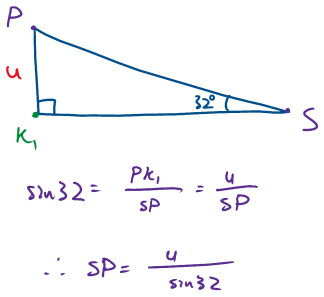
Step 2: Consider triangle PK1SPK_1S
In right triangle PK1S, sine 32 degrees is u divided by SP, so SP equals u divided by sine 32 degrees.
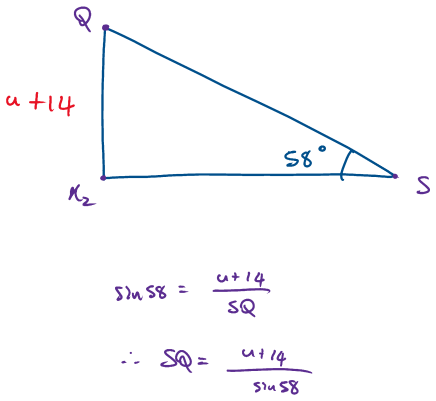
Step 3: Consider triangle QK2SQK_2S
In right triangle QK2S, sine 58 degrees is u plus 14 divided by SQ, so SQ equals u plus 14 divided by sine 58 degrees.

(a)(ii)Find u, correct to two decimal places.\text{(a)(ii)}\quad \text{Find }u\text{, correct to two decimal places.}

Step 1: Thinking

Find PQPQ using the two radii in right triangle PMQPMQ. Then use the cosine rule in triangle PSQPSQ.

Step 2: Consider triangle PSQPSQ
Triangle PSQ highlighted on the wall and beam diagram.
PQ2=PM2+MQ2=142+142=392PQ^2=PM^2+MQ^2=14^2+14^2=392
PQ=142PQ=14\sqrt{2}

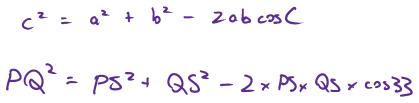
Apply the cosine rule in triangle PSQPSQ.

The handwritten cosine rule applied to triangle PSQ with an included angle of 33 degrees.
392=SP2+SQ2−2(SP)(SQ)cos⁡33∘392=SP^2+SQ^2-2(SP)(SQ)\cos 33^\circ
Step 3: Substitute and solve
392=(usin⁡32∘)2+(u+14sin⁡58∘)2−2(usin⁡32∘)(u+14sin⁡58∘)cos⁡33∘\begin{aligned}392={}&\left(\frac{u}{\sin32^\circ}\right)^2+\left(\frac{u+14}{\sin58^\circ}\right)^2\\&-2\left(\frac{u}{\sin32^\circ}\right)\left(\frac{u+14}{\sin58^\circ}\right)\cos33^\circ\end{aligned}

Expanding gives the quadratic below, with coefficients shown to six decimal places.

1.219106u2−13.321036u−119.469505≈01.219106u^2-13.321036u-119.469505\approx 0

Solve using the unrounded coefficients and take the positive root, since u>0u>0.

u=16.770380…≈16.77 mu=16.770380\ldots\approx 16.77\,\mathrm{m}

(b)Find both possible values of ∠PRT.\text{(b)}\quad \text{Find both possible values of }\angle PRT.

Step 1: Mark on diagram
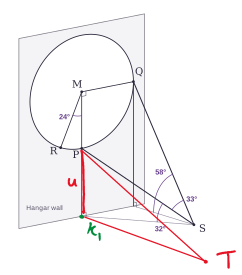
A second scanner T sits on the level ground.
The beam from T to P and its horizontal projection.
The beams from T to P and R and their horizontal projections.
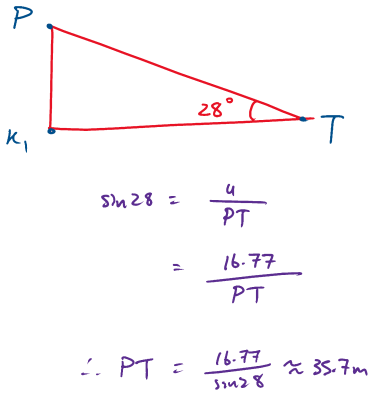
Step 2: Consider PK1TPK_1T
The handwritten sine calculation in right triangle PK1T uses the elevation of 28 degrees and gives PT approximately 35.7 metres.
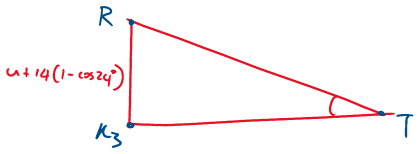
Step 3: Consider RK3TRK_3T
The height of R above K3 is u plus 14 times one minus cosine 24 degrees. The elevation from T to R is unknown.

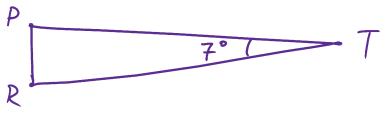
Well, it looks like we can’t do anything with this triangle. So, we can’t just recycle the previous method. Let us consider triangle PRTPRT instead. This is because the 7∘7^\circ sweep is the angle between the two beams. It does not give the elevation to RR, so consider triangle PRTPRT instead.

Step 4: Consider PRTPRT
Triangle PRT with a 7 degree angle at T.

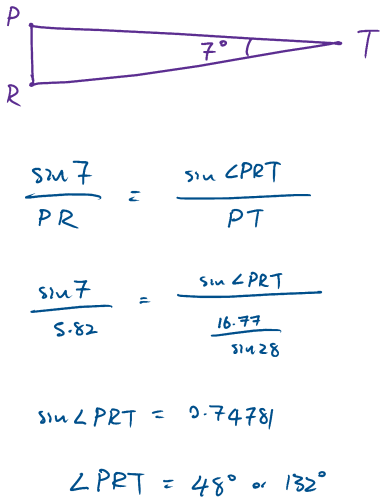
We can determine PRPR as it is a chord.

The chord PR equals twice 14 metres times sine 12 degrees, about 5.8215 metres.
Step 5: Determine angle
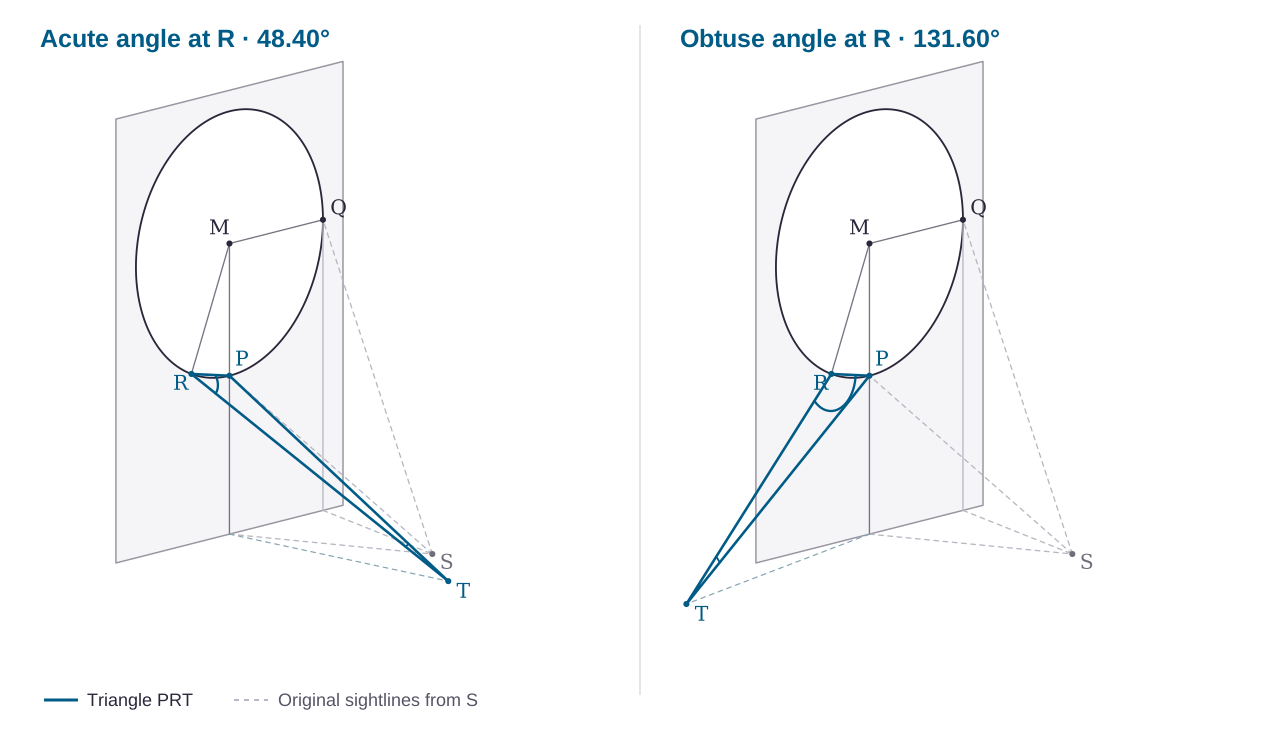
The sine rule gives sine of angle PRT approximately 0.74781, so the possible angles are 48 or 132 degrees to the nearest degree.

Both angles are possible. The diagrams below show the two ground positions for TT.

The two positions of T in front of the wall give angles at R of 48.40 and 131.60 degrees.

And don’t worry,
there’s plenty more where that came from.

3.1-to-1 support

Ask questions any time - inclass, afterclass or between classes! Contact your tutor anytime.

We don’t offer separate 1–1 tutoring.

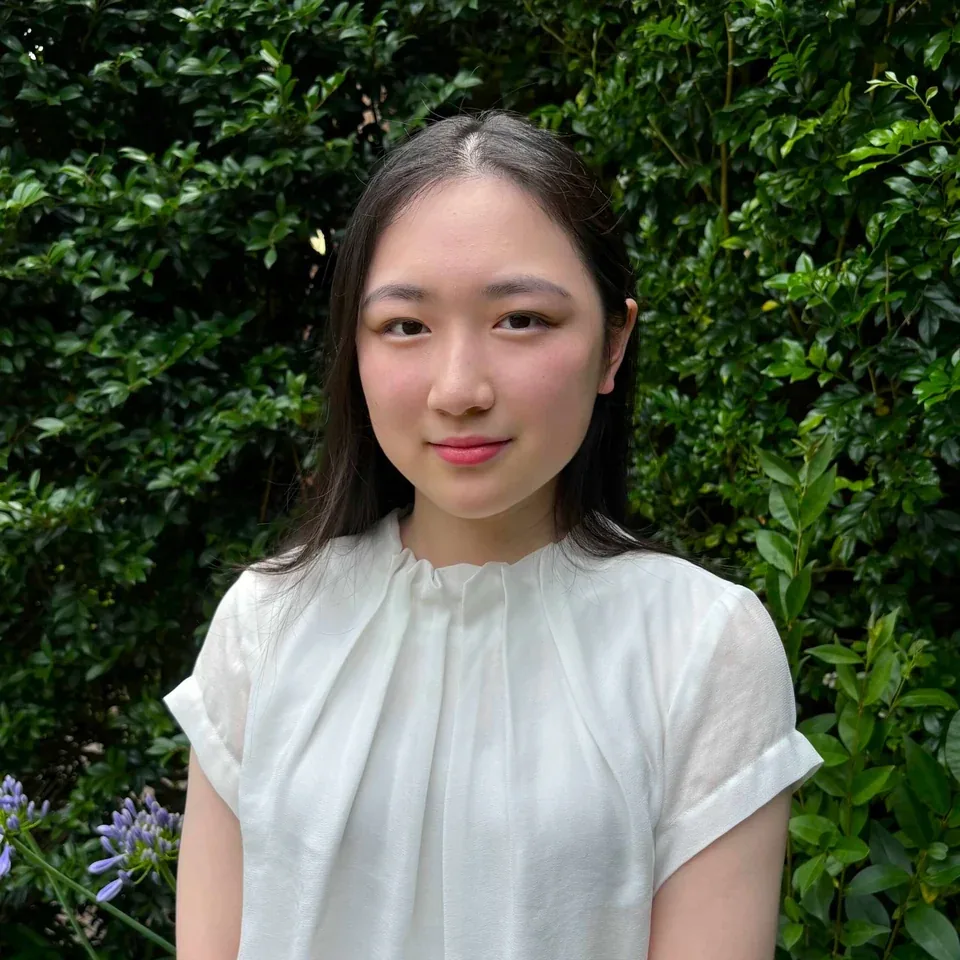
Crystal Fu Chen
1stMaths Ext 1 exam · Meriden

Wait, so what does a week at Tutorgum actually look like?

The lesson ends. The learning keeps going.

Mon
Tue
Wed
Thu
Fri
Sat
Sun
Class7–9pm
HomeworkTry exam-style questions with worked solutions to help you through.
Tutor supportAsk when a question comes up. You do not have to wait for the next class.
Find your class

Monday 7–9pm

01 / 06
  1. Quiz

  2. Review

  3. Theory

  4. Questions

  5. Theory

  6. Questions

  • ProofUse mathematical induction to prove statements about positive integers.
  • VectorsUse components and dot products to reason about angles and motion.
  • Trigonometric functionsWork with inverse trigonometric functions and their graphs.
  • CalculusBuild fluency with differentiation and integration, then apply them to problems.
  • Statistical analysisWork with the binomial distribution and the sampling distribution of the mean.

Read the NESA syllabus

A weekly class.
Support around it.

Choose your year, find a time and try a lesson.

Year 12 Maths Extension 1

$60/ hour

$120 per week

  • Includes a two-hour class
  • Homework with step-by-step solutions for every question
  • Help with any extra questions you have
  • Exam and depth study preparation
Find a Year 12 class

Currently listed classes are below. Contact us to confirm a time for the incoming accelerated or normal intake.

Class timetable

Find your class.

Why not try a class - it's risk free!

The first lesson is only charged if you want to continue, otherwise it's totally free!

FAQ

Does Year 12 Maths Extension 1 tutoring include Advanced Maths?

Yes. Our live online Year 12 Extension 1 class includes Advanced Maths. In Extension 1, we practise choosing a method in calculus, vectors and proof when the question leaves the approach up to you.

Which year is currently on the timetable?

The published class is for Year 12. If you’re in Year 11, get in touch to ask about class options.

What happens when I book a trial?

Send us your year, subject and preferred class. We’ll help you find a suitable lesson. The first lesson is only charged if you want to continue, otherwise it's totally free!

Group lessons don't work for my child. They're too shy to ask questions.

I was always that shy boy. I was scared to ask questions - I was scared of what other people would think.

  • Students can ask questions 1-1 after class, or between classes via email/text.
  • I ask every student questions during class – so everyone is forced to interact.
  • I monitor every student to see if they’re falling behind.

If you definitely need a 1-1 setting, then you should hire someone else.

But, is the setting more important to you, than your child getting an expert? There’s a lot of tutors out there. But how many of them have topped NSW? Not all of them know chemical equilibrium and electromagnetism like I do. Or how to explain it to get the "Aha!" moment. Or why students lose marks. Or how to fix it. And that means they won't produce results, like helping Kirsten Chu, 2022, move from 56% to 91%.

Can my child catchup to the group pace?

No one wants to be in an environment where they're far behind everyone else. To help you judge if it's suitable, the average student we get comes in with marks at, or a bit below average. We get a mix of selective (NSB, NSG, Ruse etc), private (Scots, St Patricks, Meriden etc) and comprehensive schools (Castle Hill, Carlingford HS etc). We help them catchup by answering questions after class and providing support material for previous topics.

In class when we go through a new topic, we will always explain it from scratch - so even if you have missed out on previous concepts, it won't stop you from getting the new ones.

But what if my child has questions?

Our group is run differently to most tutors. I am willing to spend 1-1 time with you. If you have questions – you can ask me 1-1 after class! And throughout the week! I’ll spend an hour with you if you need it.

How do your classes work?

We have one 2 hour session per week. It's online, via Zoom.

What do you do in class?

We start the lesson with a 10 min quiz. Then we go through a new concept and then do a few questions to solidfy it. Then we repeat this for the whole lesson. When exam time comes, we do revision lessons where a practice exam is sent before class, and the hard questions students request are reviewed in class.

How does payment work?

We accept payment via Bank Transfer. We typically bill termly. If you wish to discontinue, all unused lessons will be refunded, in full, to you.

What if I miss a lesson?

We highly recommend not to skip lessons for exams - if you are pressed for time, it is best if you skip the homework but come anyway. If you are away for a lesson, all materials will be provided and a recording will be made for you, however, the lesson will not be refunded.

Do you have other class times?
Do you have classes in the holidays?

Yes - classes run as per usual. It's as if the holidays do not exist. But we do not run intensive lessons in the holidays as they are ineffective for students.

Group size

It varies, but often hovers around 5

What do students need to join online?

Enthusiasm, pen, and preferably a dedicated book. All other resources will be sent.

How do you prepare students for School Exams?

The major reason why students do not do well in their exams is because they lack knowledge of the core concepts. After doing content with us, most students do not experience this anymore. From this strong foundation, we do weekly exam style problems in the homework - meaning weekly practice for exams.

Just before exams, we will also give access to our private collection of school past papers which is the best practice. We will also go through exam technique in class before exams.

But that order isn't what my school is doing!

Some schools do decide to do it out of order. In my experience, this is ok because the same content is covered by the time you sit the exam. The most important factor is that the student learns something - even if it's not synchronised with school.

What is your typical student like?

Our students typically come with marks at, or a bit below average. We get a mix of selective (NSB, NSG, Ruse etc), private (Scots, St Patricks, Meriden etc) and comprehensive schools (Castle Hill, Carlingford HS etc).

What does a good candidate for your program look like?

Your improvement does not depend on how smart you are. The most important quality that determines success in the program is your willingness to work. Students that have shown dramatic improvements like Jade Yang and Kirsten Chu put in 10h+ per week into Physics and Chemistry. We make it easy for you - as long as you do all the homework (exam practice) and come to every class, you will improve.

The question is - will you do it?

Can I join from Sydney, regional NSW or outside NSW?

Yes. Classes are online, so you can join from Sydney, Newcastle, Wollongong, regional NSW or elsewhere in Australia. You do not need to travel to a tutoring centre.

The Physics and Chemistry courses are designed for the NSW HSC. If you study another state's syllabus or a different curriculum, contact us with your year and topics so we can discuss whether the course is suitable. Online access does not mean every curriculum is covered.

Still have a question?

Call 0490 496 078