Tutorgum
Subukan ang isang klase

HSC tutoring sa Pisika.
Maliliit na grupo. Online.

May dalawang oras na klase sa maliit na grupo sa Zoom bawat linggo. May mga takdang-araling kahawig ng mga tanong sa pagsusulit, na may sunod-sunod na solusyon. Maaari ring magtanong nang isa-sa-isa sa tutor.

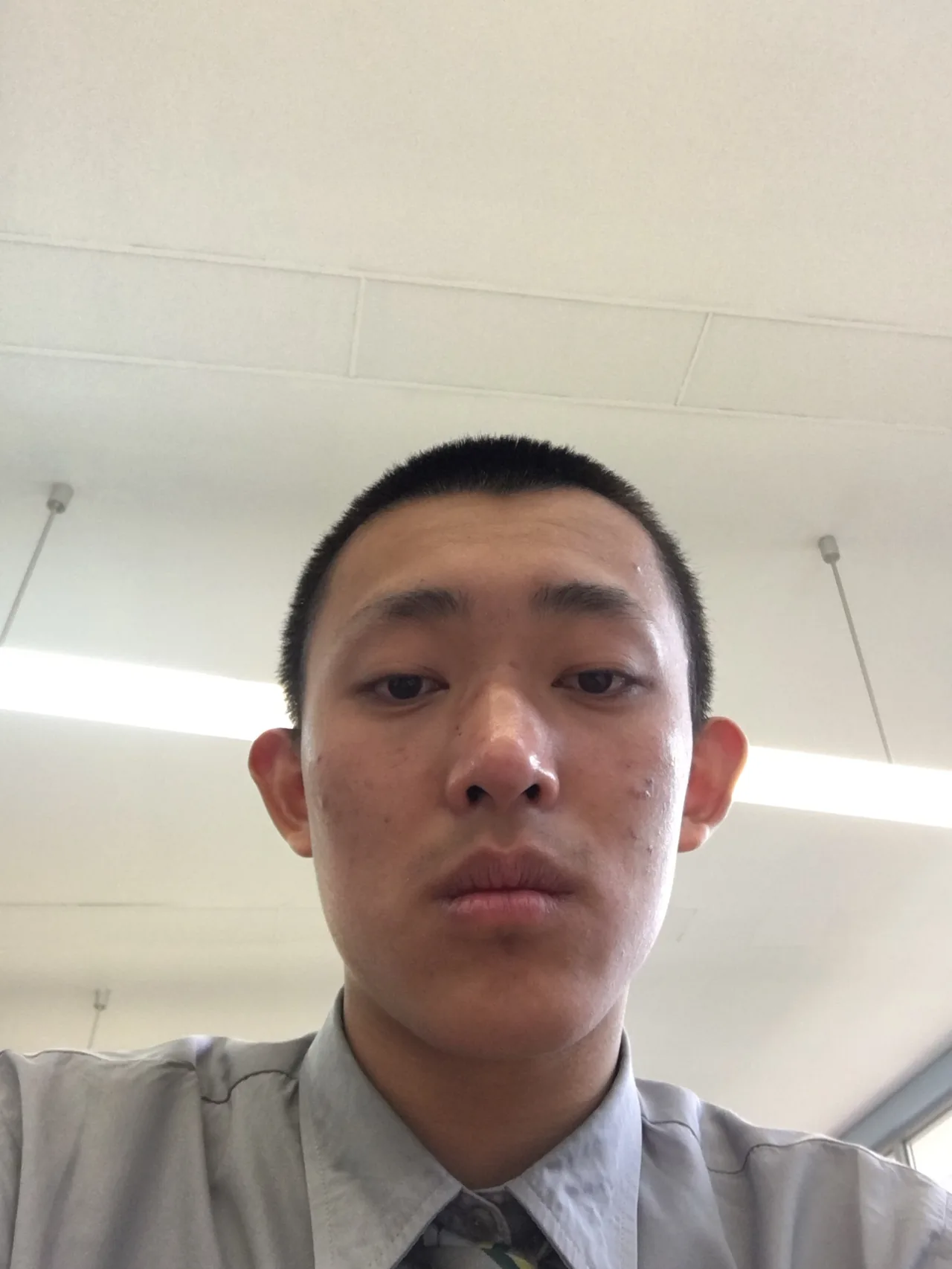
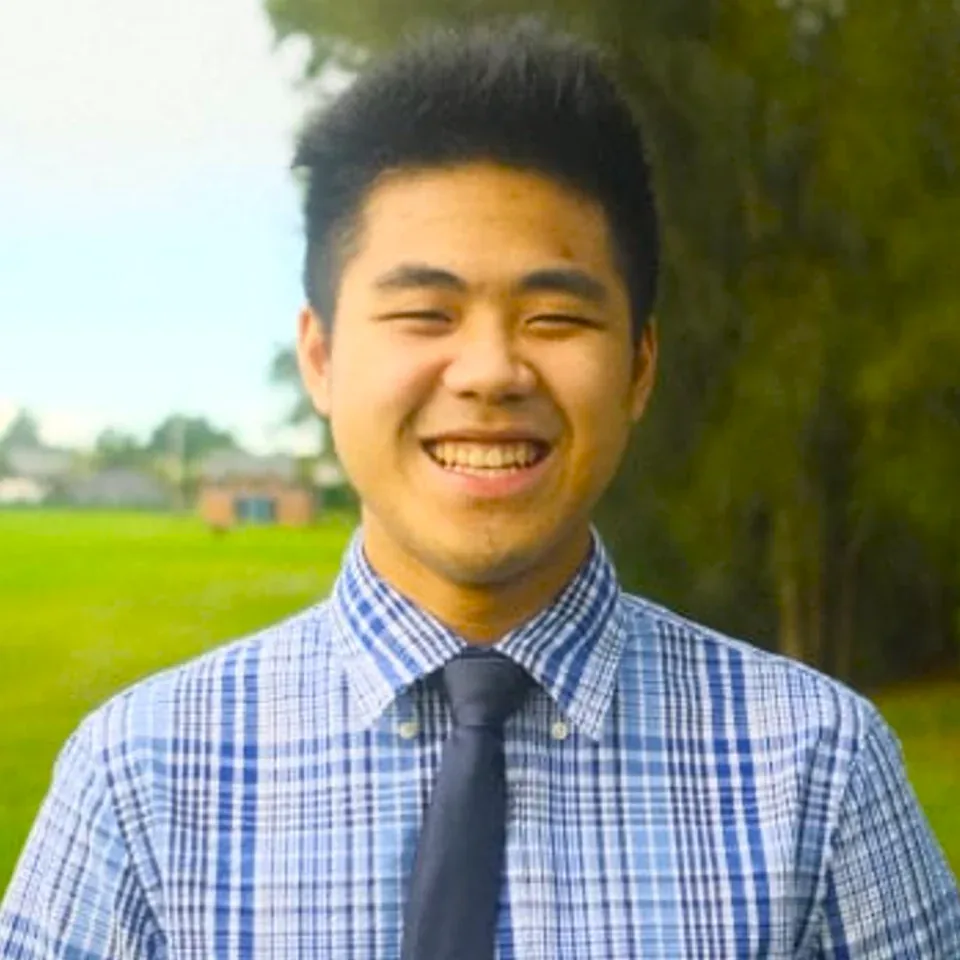
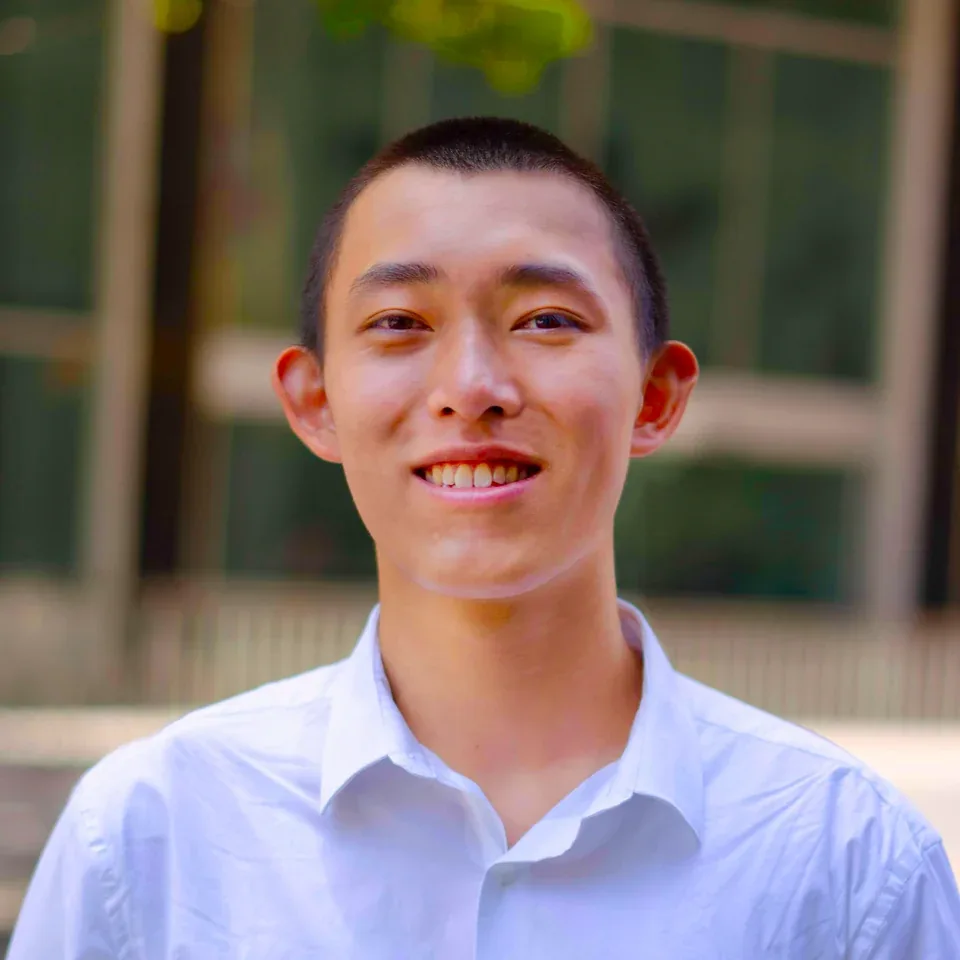
Bob’s Year 10 selfie in his school uniform
50th in
James Ruse Science
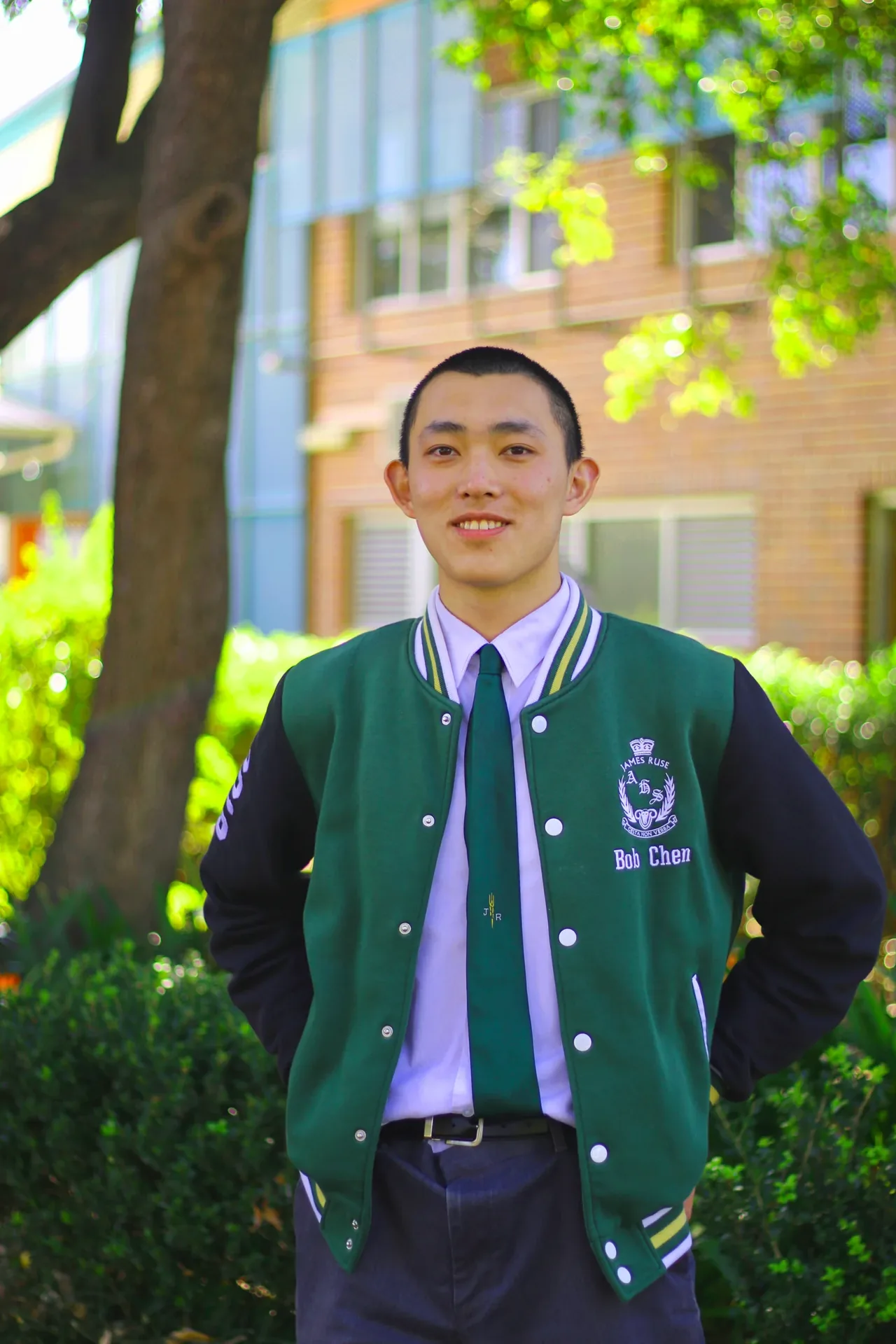
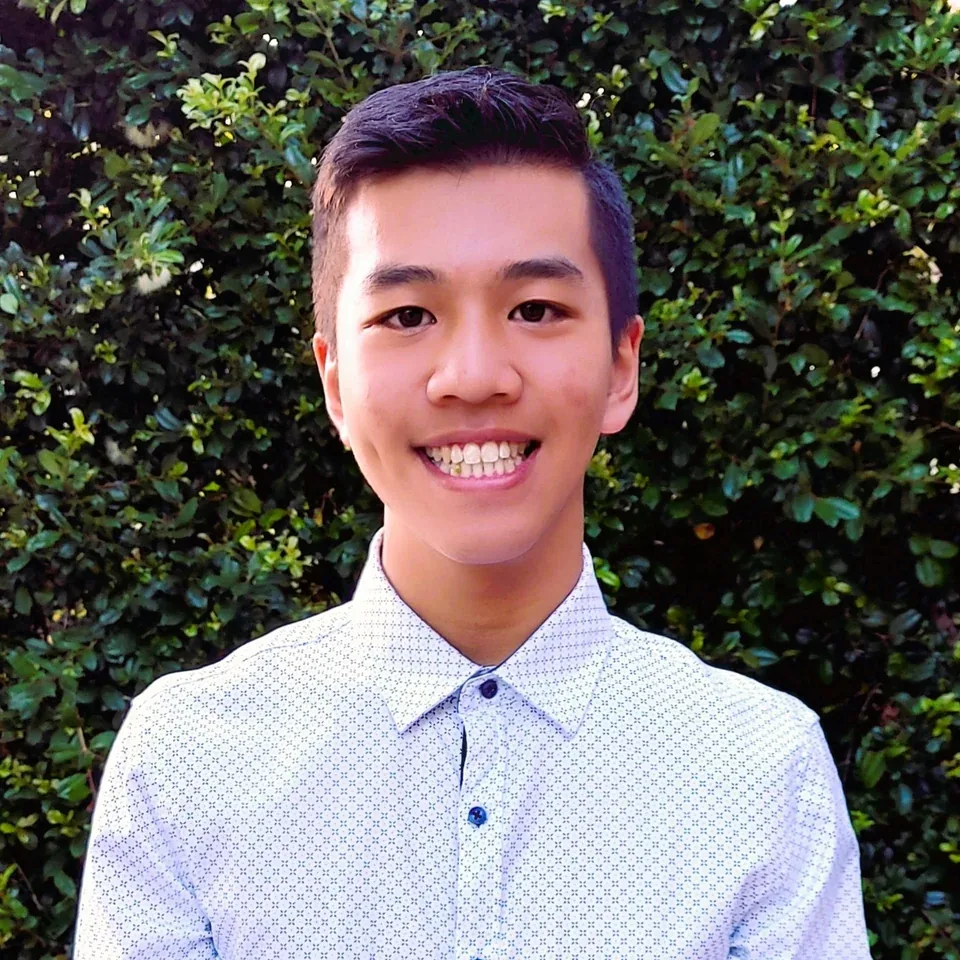
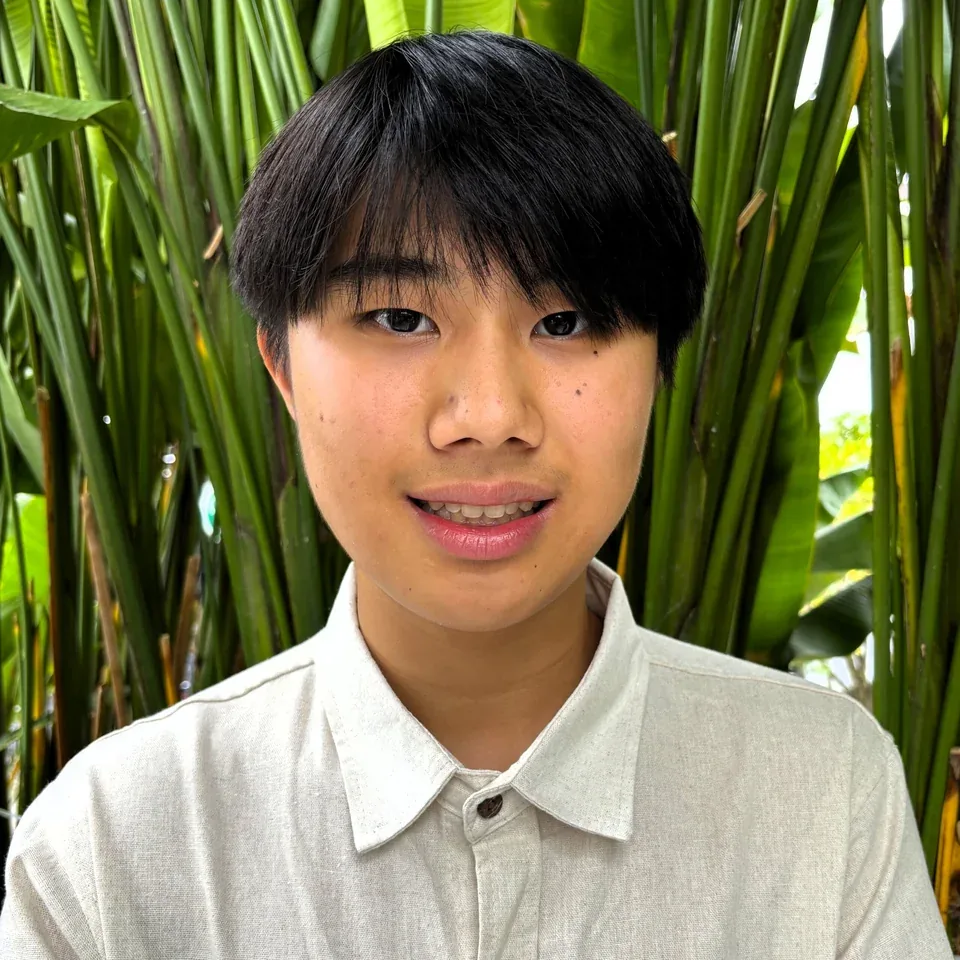
Bob in Year 12 wearing his James Ruse school jacket
1st in
Ruse Physics

Physics state rank99.85 ATARUSYD Med

HSC tutoring sa Physics, Chemistry at Mathematics.

Manood ng 10 minutong demo

Tagumpay ng aming mga mag-aaral

Basahin ang buong kuwentoBasahin ang buong kuwento

Ang kuwento sa likod ng Tutorgum.

Bago ako naging una sa Physics sa James Ruse, natatakot akong sabihin kay Nanay ang mga marka ko.

Selfie ni Bob na naka-uniporme noong Year 10
Ika-50 sa cohort sa Science sa James Ruse
Si Bob na suot ang jacket ng James Ruse noong Year 12
Una sa Physics sa James Ruse

Unang ranggo sa Physics sa buong NSWATAR 99.85Medisina sa University of Sydney

Skip story

Bago ako naging una sa Physics sa James Ruse,natatakot akong sabihin kay Nanay ang mga marka ko.

Bago ako naging una sa Physics sa James Ruse,
natatakot akong sabihin kay Nanay ang mga marka ko.

Ganito ako noong Year 10.

Hindi magaling.

Pero may isang bagay na mas malala pa ako kaysa mag-selfie.

Agham.

Dahil hindi maganda ang mga marka ko.

Naku.
Ika-50 ako sa buong cohort.

Ayaw ko sa agham.

Nag-aral ako. Nagsaulo. Nagsanay.

Mali pa rin ang formula na ginagamit ko.
Nanghuhula ako sa mga pagsusulit.

Hindi ako nakaabot sa mataas na ranggo o nakakuha ng lampas 90%.

Nawalan ako ng kontrol.

Ayokong sabihin kay Nanay ang mga marka ko.

Kaya alam kong may kailangang magbago.

Kalaunan, nakamit ko ang

  1. Una sa Physics sa James Ruse: unang puwesto.
  2. Unang ranggo sa Physics sa buong NSW: unang ranggo.
  3. ATAR 99.85.
  4. Medisina sa USYD.

Mga biswal na paliwanag mula sa pinakapundasyon.

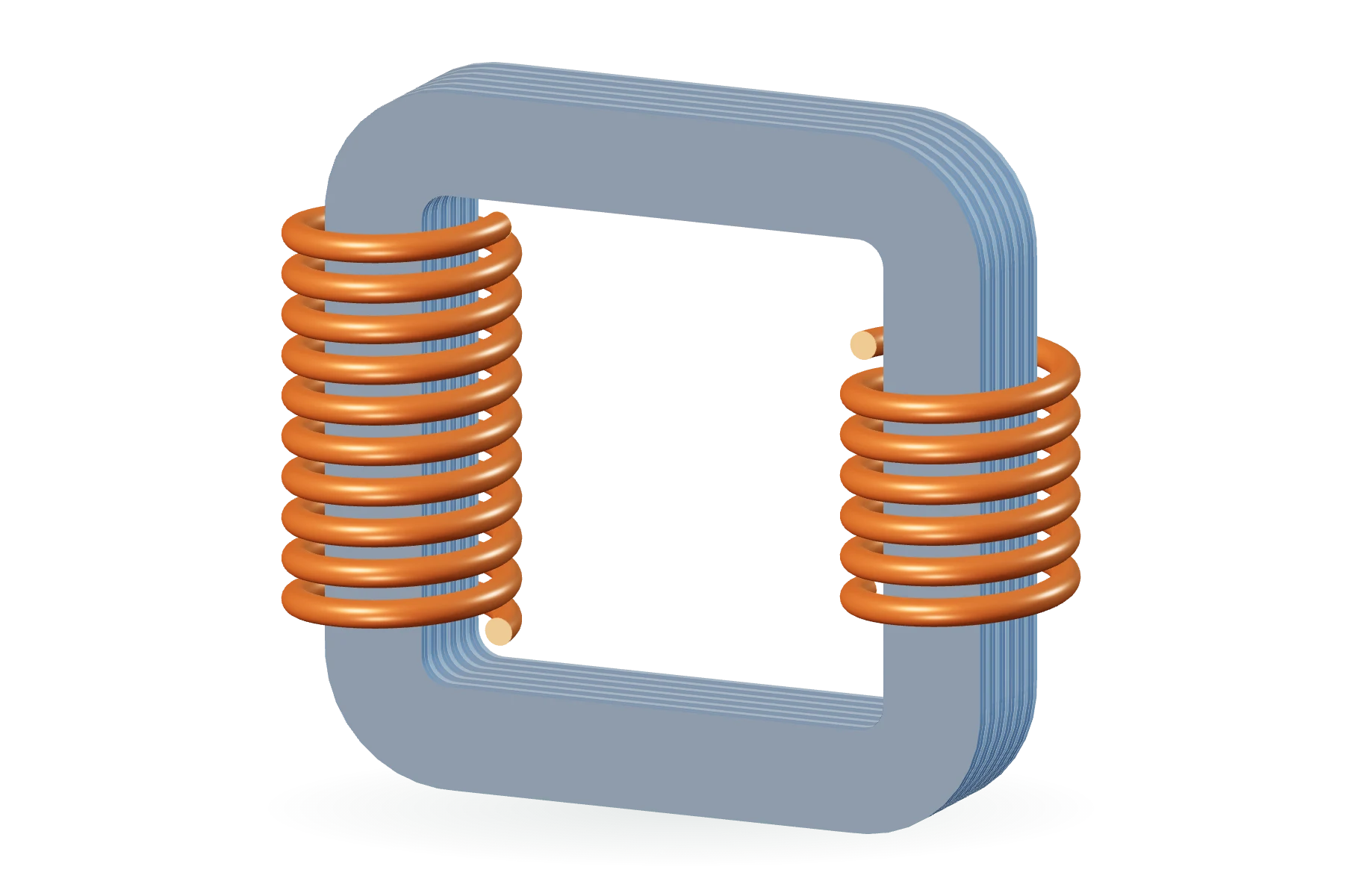
Dalawang copper coil ang nakapulupot sa laminated iron core. Lumilikha ng nagbabagong magnetic field ang palitang kuryente sa unang coil, na nag-iinduce ng boltahe sa ikalawang coil.

Lahat tayo ay nag-aaral tungkol sa mga transformer. Pero naisip mo na ba kung bakit ganoon ang bawat bahagi?

Bawasan muna natin ito sa mga pangunahing bahagi—dalawang coil lang ng wire.

Kapag dumadaloy ang kuryente sa wire, nagkakaroon ng magnetic field sa paligid nito.

Kapag pinulupot natin ang wire, nagiging solenoid ito at lumilikha ng magnetic field.

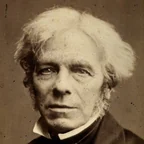
Nag-iinduce ng boltahe sa kanang coil ang nagbabagong magnetic field ng kaliwang coil. Ito angbatas ni Faraday.Larawan ni Michael Faraday

Ginagamit ng mga wireless charger ang ayos na ito na walang core. Pero maaari pa natin itong gawing mas episyente!

Magdagdag tayo ng soft iron core. Pinapalakas nito ang magnetic field ng kaliwang coil.

Mahalaga ang pagpapahaba ng iron hanggang sa kanang coil: mas maraming magnetic flux ang nakararating at nagbabago roon.

Isara ang iron loop para magkaroon ng daanan pabalik ang magnetic field.

Binabawasan ng magkakahiwalay na insuladong iron sheet ang eddy current at init. Iyan ang buong transformer!

2.Takdang-araling kahawig ng pagsusulit

Alam mo kung ano ang
natututuhan sa paaralan…

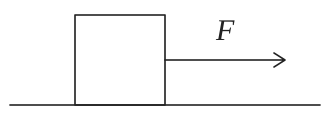
Isang bloke sa patag na sahig na tinutulak pakanan ng iisang pahalang na puwersang F.F

Pero pagdating sa exam,
ganito ang tanong…
But then, in the exam, ganito ang tanong…

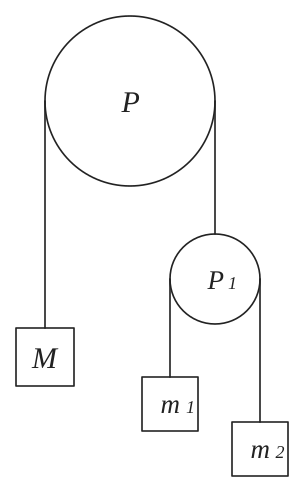
Tatlong bagay na pinagdurugtong ng dalawang pulley: nakasabit ang bigat na M sa malaking pulley P, na sumusuporta sa mas maliit na P₁ kung saan nakasabit ang m₁ at m₂.PP1Mm1m2

Paano kung ganitong mga tanong ang takdang-aralin mo bawat linggo?

Year 12 Physics · Mga nakahilig na kurba

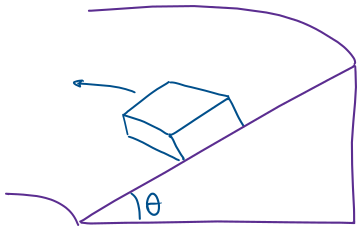
Ang isang kurbang may radius na 78 m ay nakahilig nang 10 digri. Ang coefficient of friction ay 0.1.

  1. Ano ang ideal na bilis para makadaan ang sasakyan nang hindi gumagamit ng friction?
  2. Ano ang pinakamababang bilis para sa likong ito?
  3. Ipagpalagay na ngayon ay 0.3 ang coefficient of friction. Sa anong saklaw ng bilis makakadaan ang sasakyan sa liko? Ipaliwanag kung bakit negatibo ang makukuhang bilis.

At may kumpletong solusyon sa bawat tanong, hakbang-hakbang.

Buksan lahatIpakita nang mas kaunti

a) Ano ang ideal na bilis para makadaan ang sasakyan nang hindi gumagamit ng friction?

ANSWER

Step 1: Force diagram
Step 2: Force analysis

Considering the x – there is a net force! The horizontal part of tension must be the centripetal force!

Considering the y – there is no net force. Thus the vertical part of tension must balance the weight force

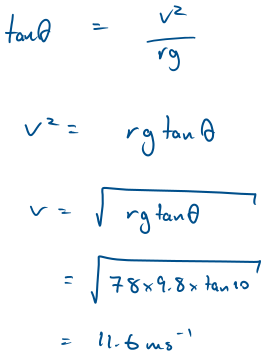
Step 3: Set up equation
Step 4: Plug and chug

b) Ano ang pinakamababang bilis para sa likong ito?

ANSWER

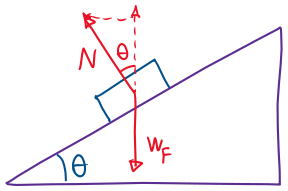
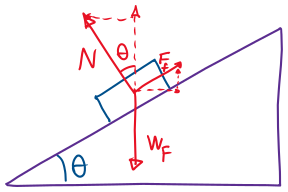
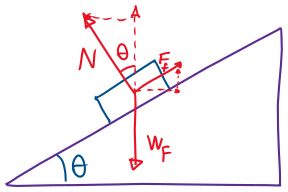
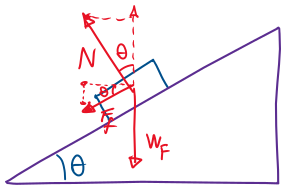
Step 1: Draw force diagram

The force of friction must point up the slope. When the car goes really slow, the car will slip towards the centre.

Step 2: Write out force equations

Vertically:

Ncos⁡θ+Ffsin⁡θ=Wf(1)N\cos \theta +{F}_{f}\sin \theta ={W}_{f}\quad (1)

Horizontally:

FC=Nsin⁡θ−Ffcos⁡θ(2){F}_{C}=N\sin \theta -{F}_{f}\cos \theta \quad (2)

If we transform them:

FC=−Ffcos⁡θ+Nsin⁡θ(2)′{F}_{C}=-{F}_{f}\cos \theta +N\sin \theta \quad {(2)}^{'}
Wf=Ff+sin⁡θ+Ncos⁡θ(1)′{W}_{f}={F}_{f}+\sin \theta +N\cos \theta \quad {(1)}^{'}
Step 3: Maths
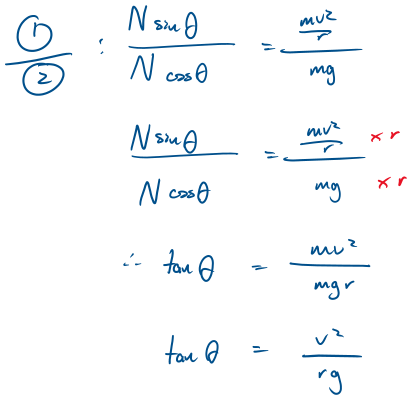
(2)′(1)′FCWf=−Ffcos⁡θ+Nsin⁡θFf+sin⁡θ+Ncos⁡θ\frac{{(2)}^{'}}{{(1)}^{'}} \frac{{F}_{C}}{{W}_{f}}=\frac{-{F}_{f}\cos \theta +N\sin \theta }{{F}_{f}+\sin \theta +N\cos \theta }
mv2rmg=−μNcos⁡θ+Nsin⁡θμN+sin⁡θ+Ncos⁡θ\frac{\frac{m{v}^{2}}{r}}{mg}=\frac{-\mu N\cos \theta +N\sin \theta }{\mu N+\sin \theta +N\cos \theta }
v2rg=−μcos⁡θ+sin⁡θμsin⁡θ+cos⁡θ\frac{\frac{{v}^{2}}{r}}{g}=\frac{-\mu \cos \theta +\sin \theta }{\mu \sin \theta +\cos \theta }
v2=−0.1cos⁡10+sin⁡100.1sin⁡10+cos⁡10×78×9.8{v}^{2}=\frac{-0.1\cos 10+\sin 10}{0.1\sin 10+\cos 10}\times 78\times 9.8
v=7.6ms−1v=7.6 {ms}^{-1}

c) Ipagpalagay na ngayon ay 0.3 ang coefficient of friction. Sa anong saklaw ng bilis makakadaan ang sasakyan sa liko? Ipaliwanag kung bakit negatibo ang makukuhang bilis.

ANSWER

If you do the calculations, you’ll see that the min speed is negative!

What does this mean!?

It means there is no minimum speed. At any speed the friction will prevent you from sliding down. You could be going at 0m/s and you’ll be able to stay on the curve (there’s just a lot of friction!). it’s like how you can stand on a slanted hill surface.

Step 1: Force equations

Vertically:

Ncos⁡θ+Ffsin⁡θ=Wf(1)N\cos \theta +{F}_{f}\sin \theta ={W}_{f}\quad (1)

Horizontally:

Fc=Nsin⁡θ−Ffcos⁡θ(2){F}_{c}=N\sin \theta -{F}_{f}\cos \theta \quad (2)

At maximum friction:

Ff=μN{F}_{f}=\mu N
Step 2: Maths

Dividing (2) by (1):

FcWf=−μNcos⁡θ+Nsin⁡θμNsin⁡θ+Ncos⁡θ\frac{{F}_{c}}{{W}_{f}}=\frac{-\mu N\cos \theta +N\sin \theta }{\mu N\sin \theta +N\cos \theta }
mv2/rmg=−μcos⁡θ+sin⁡θμsin⁡θ+cos⁡θ\frac{m{v}^{2}/r}{mg}=\frac{-\mu \cos \theta +\sin \theta }{\mu \sin \theta +\cos \theta }
v2rg=−0.3cos⁡10+sin⁡100.3sin⁡10+cos⁡10\frac{{v}^{2}}{rg}=\frac{-0.3\cos 10+\sin 10}{0.3\sin 10+\cos 10}
v2=−89.8{v}^{2}=-89.8

Since v2{v}^{2} cannot be negative, there is no minimum speed.

Step 3: Maximum speed

Friction now acts down the slope, as the car tends to slide up the slope.

Vertically:

Ncos⁡θ−Ffsin⁡θ=Wf(1)N\cos \theta -{F}_{f}\sin \theta ={W}_{f}\quad (1)

Horizontally:

Fc=Nsin⁡θ+Ffcos⁡θ(2){F}_{c}=N\sin \theta +{F}_{f}\cos \theta \quad (2)

Using Ff=μN{F}_{f}=\mu N, divide (2) by (1):

FcWf=μNcos⁡θ+Nsin⁡θNcos⁡θ−μNsin⁡θ\frac{{F}_{c}}{{W}_{f}}=\frac{\mu N\cos \theta +N\sin \theta }{N\cos \theta -\mu N\sin \theta }
v2rg=μcos⁡θ+sin⁡θcos⁡θ−μsin⁡θ\frac{{v}^{2}}{rg}=\frac{\mu \cos \theta +\sin \theta }{\cos \theta -\mu \sin \theta }

Substitute:

v2=78(9.8)(0.3cos⁡10+sin⁡10cos⁡10−0.3sin⁡10){v}^{2}=78(9.8)(\frac{0.3\cos 10+\sin 10}{\cos 10-0.3\sin 10})
v=384.4v=\sqrt{384.4}
v=19.6m/sv=19.6 m/s

Hence the range of speeds is

0≤v≤19.6m/s0\leq v\leq 19.6 m/s

And don’t worry,
there’s plenty more where that came from.

3.Indibidwal na suporta ng tutor

Magtanong sa klase, pagkatapos nito o anumang oras sa pagitan ng dalawang klase. Makipag-ugnayan sa tutor mo anumang oras.

Hindi kami nag-aalok ng hiwalay na one-to-one tutoring.

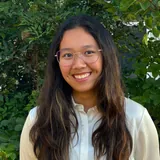
Bob Chen
7thNSW Physics state rank
Jerome Shin
100%Maths Ext 1 exam · James Ruse

Ano nga ba ang karaniwang linggo sa Tutorgum?

Tapos na ang klase. Tuloy ang pagkatuto.

Lun
Mar
Miy
Huw
Biy
Sab
Lin
Klase7–9pm
Takdang-aralinSagutan ang mga tanong na kahawig ng pagsusulit at gamitin ang mga hakbang-hakbang na solusyon bilang gabay.
Tulong ng tutorMagtanong kapag may sumagi sa isip mo. Hindi mo kailangang maghintay sa susunod na klase.
Hanapin ang klase mo

Lunes 7–9pm

01 / 06
  1. Pagsusulit

  2. Pagbabalik-aral

  3. Teorya

  4. Mga tanong

  5. Teorya

  6. Mga tanong

Balangkas ng kurso sa Pisika
Sunod-sunod na module.

Ipakita ang mga term sa paaralanItago ang mga term sa paaralan
Tuloy ang klase kahit bakasyon sa paaralanDalawang linggong pahinga tuwing Pasko at Bagong Taon
Modyul 1: Fundamentals of mechanicsMotion, forces, energy and momentum — lingguhang balangkasMay klase pa rin tuwing Bakasyon pagkatapos ng Term 2

Nagsisimula sa Linggo 1 ang bilang ng bawat modyul. Batay sa kasalukuyang plano ang mga lingguhang paksa at sinusuri ang mga ito para sa bagong syllabus.

  1. Linggo 1
    Vectors and motion

    Distinguish scalars and vectors, then connect displacement, speed and velocity to everyday motion.

  2. Linggo 2
    Motion graphs and relative velocity

    Interpret displacement, velocity and acceleration graphs and describe motion from another observer's perspective.

  3. Linggo 3
    SUVAT and free fall

    Apply constant-acceleration equations to harder motion problems, including objects moving under gravity.

  4. Linggo 4
    Adding vectors

    Add and subtract vectors, resolve perpendicular components and solve motion problems in two dimensions.

  5. Linggo 5
    Motion practice and a first look at forces

    Practise vector and motion questions, then introduce forces as the next step in explaining motion.

  6. Linggo 6
    Forces and free-body diagrams

    Review Newton's laws, identify the forces on an object and build useful free-body diagrams.

  7. Linggo 7
    Friction, tension and net force

    Work through friction and tension questions and combine forces to find the net force.

  8. Linggo 8
    Inclined planes and connected systems

    Resolve forces on slopes, include drag and analyse objects connected as a system.

  9. Linggo 9
    Work and energy

    Define work as energy transfer by a force and apply it to force and displacement questions.

  10. Linggo 10
    Power and gravitational potential energy

    Connect force, velocity and power, then examine changes in gravitational potential energy.

  11. May klase pa rin tuwing Bakasyon pagkatapos ng Term 2
  12. Linggo 11
    Conservation of mechanical energy

    Choose a convenient zero for potential energy and solve harder gravitational and kinetic energy problems.

  13. Linggo 12
    Momentum and collisions

    Introduce momentum and use collision examples to predict how interacting objects move.

  14. Linggo 13
    Conservation of momentum

    Analyse collisions, objects sticking together and explosions; compare momentum and kinetic energy.

  15. Linggo 14
    Collisions in two dimensions at Dynamics consolidation

    Resolve momentum in perpendicular directions and practise angled collisions and module questions. Revisit the module's harder questions and consolidate the final Dynamics practice.

Modyul 2: WavesWave properties, sound and light — lingguhang balangkasMay klase pa rin tuwing Bakasyon pagkatapos ng Term 3

Nagsisimula sa Linggo 1 ang bilang ng bawat modyul. Batay sa kasalukuyang plano ang mga lingguhang paksa at sinusuri ang mga ito para sa bagong syllabus.

  1. Linggo 1
    Wave models and wave graphs

    Compare wave types, read displacement graphs and connect wave motion to energy transfer.

  2. Linggo 2
    Huygens' model and wave behaviour

    Explore longitudinal waves and use wavefronts to explain reflection and diffraction.

  3. Linggo 3
    Sound and resonance

    Connect natural frequency and resonance to sound, pitch and the inverse-square relationship.

  4. Linggo 4
    Standing waves

    Explain sound interference and resonance, then construct standing waves in strings and pipes.

  5. Linggo 5
    Refraction and Snell's law

    Explain refraction using changes in wave speed, then apply refractive index, Snell's law and dispersion.

  6. Linggo 6
    Total internal reflection and ray diagrams

    Use the critical angle to explain total internal reflection and practise ray diagrams and image formation.

  7. Linggo 7
    Lenses and image formation

    Compare converging and diverging lenses, trace images and revisit the earlier wave topics.

  8. Linggo 8
    Temperature, heat and internal energy

    Distinguish temperature, heat and internal energy; apply calorimetry and examine phase changes.

  9. May klase pa rin tuwing Bakasyon pagkatapos ng Term 3
  10. Linggo 9
    Thermal transfer

    Explain conduction, convection and radiation and apply thermal conductivity to heat-transfer questions.

  11. Linggo 10
    Lesson focus to be confirmed at Waves and thermodynamics revision

    Ask your tutor which topics this class will cover. Consolidate the module through revision and practice questions.

Modyul 3: Electricity and magnetismCharges, circuits and magnetic fields — lingguhang balangkasMay klase pa rin tuwing Bakasyon pagkatapos ng Term 4

Nagsisimula sa Linggo 1 ang bilang ng bawat modyul. Batay sa kasalukuyang plano ang mga lingguhang paksa at sinusuri ang mga ito para sa bagong syllabus.

  1. Linggo 1
    Charge and Coulomb's law

    Describe electric charge, compare charging methods and calculate forces between charges.

  2. Linggo 2
    Electric fields and voltage

    Draw electric fields and connect field strength, force and electric potential difference.

  3. Linggo 3
    Uniform fields and electric energy

    Compare uniform and non-uniform fields, examine fringe effects and use work and equipotential ideas.

  4. Linggo 4
    Current, resistance and circuits

    Introduce current and resistance, apply Ohm's law and compare electrical power, AC and DC.

  5. Linggo 5
    Series circuits and electrical models

    Explain current and voltage in circuits and calculate equivalent resistance and voltage drops.

  6. Linggo 6
    Kirchhoff's laws

    Apply the junction and loop rules to determine currents and voltages in circuits.

  7. Linggo 7
    Magnetic fields

    Explore magnetic poles, Earth's field and the rules for drawing magnetic field lines.

  8. Linggo 8
    Fields around wires and solenoids

    Use moving charges to explain magnetic fields around current-carrying wires, loops and solenoids.

  9. May klase pa rin tuwing Bakasyon pagkatapos ng Term 4
  10. Linggo 9
    Magnetic forces

    Use right-hand rules and force equations for moving charges and current-carrying conductors.

  11. Linggo 10
    Electricity and magnetism revision

    Review charging, fields, circuits, Kirchhoff's laws and magnetic-force directions.

Prelim prepModule review and preliminary exam practice — lingguhang balangkas

Nagsisimula sa Linggo 1 ang bilang ng bawat modyul.

  1. Linggo 1
    Kinematics review at Dynamics review at Waves and thermodynamics review at Electricity and magnetism review

    Revisit SUVAT, motion problem-solving strategies and common limiting cases. Review work, energy and momentum, including elastic and inelastic collisions. Revise wave classifications, propagation and graphs through exam-style questions. Review charging and electrical concepts alongside feedback on the preceding module paper.

  2. Linggo 2
    Preliminary mock paper 1 at Preliminary mock paper 2 at Preliminary mock paper 3

    Practise mixed preliminary questions, including river-boat motion and momentum. Work through a second mock paper with attention to connected-system reasoning. Practise the latest third preliminary mock paper and review your working.

Modyul 5: Advanced MechanicsProjectiles, circular motion and gravity — lingguhang balangkas

Nagsisimula sa Linggo 1 ang bilang ng bawat modyul.

  1. Linggo 1
    Projectile motion

    Revise kinematics and vector resolution, then analyse projectiles launched at an angle.

  2. Linggo 2
    Harder projectile problems

    Build a systematic approach to horizontal and vertical motion, including hidden information and unknowns.

  3. Linggo 3
    Circular motion

    Connect period, speed and centripetal acceleration and distinguish centripetal and centrifugal descriptions.

  4. Linggo 4
    Forces in circular motion

    Use friction, tension and banked-track examples to identify the inward force.

  5. Linggo 5
    Non-uniform circular motion

    Analyse banked tracks with friction and explore the changing forces in vertical circular motion.

  6. Linggo 6
    Circular motion and energy

    Apply radial and tangential reasoning and energy ideas to roller-coaster and circular-motion questions.

  7. Linggo 7
    Orbits and Kepler's laws

    Combine gravitation and centripetal force to find orbital speed and interpret Kepler's laws.

  8. Linggo 8
    Gravitational potential energy

    Use an infinity reference for gravitational potential energy and compare it with near-Earth approximations.

  9. Linggo 9
    Orbital transfers and mechanics review

    Explore Newton's cannon and orbital transfers, then revisit challenging projectile and circular-motion questions.

  10. Linggo 10
    Advanced Mechanics exam practice

    Work through the latest Module 5 exam and consolidate the module's problem-solving techniques.

Bakasyon sa Pasko at Bagong Taon2 linggong pahinga
Modyul 6: ElectromagnetismFields, motors and induction — lingguhang balangkasMay klase pa rin tuwing Bakasyon sa tag-init

Nagsisimula sa Linggo 1 ang bilang ng bawat modyul.

  1. May klase pa rin tuwing Bakasyon sa tag-init
  2. Linggo 1
    Fields and the Lorentz force

    Review electric and magnetic fields and introduce forces on moving charges.

  3. Linggo 2
    Charged particles in fields

    Apply the Lorentz force to particle paths and harder electric and magnetic field questions.

  4. Linggo 3
    The motor effect

    Explain forces on current-carrying conductors and interactions between parallel wires.

  5. Linggo 4
    Magnetic flux and Faraday's law

    Define magnetic flux and use changing flux to explain induced electromotive force.

  6. Linggo 5
    Lenz's law and eddy currents

    Determine induced-current directions and explain applications of eddy currents.

  7. Linggo 6
    Transformers

    Connect induction to transformer operation, practical limitations and induction applications.

  8. Linggo 7
    DC motors

    Revise torque and explain how coils, brushes and commutators make a DC motor work.

  9. Linggo 8
    Motor applications and back EMF

    Compare motor arrangements and explain the role of back EMF in operation.

  10. Linggo 9
    Generators and back torque

    Explain generator operation and the opposing torque associated with electromagnetic induction.

  11. Linggo 10
    AC induction motors and braking

    Explore induction motors, three-phase arrangements and electromagnetic braking.

  12. Linggo 11
    Electromagnetism exam practice

    Practise exam-style electromagnetic questions and review the module's key ideas.

Modyul 7: The Nature of LightWaves, photons and relativity — lingguhang balangkasMay klase pa rin tuwing Bakasyon pagkatapos ng Term 2

Nagsisimula sa Linggo 1 ang bilang ng bawat modyul.

  1. Linggo 1
    Maxwell, Hertz and light

    Trace the development and verification of the electromagnetic model of light.

  2. Linggo 2
    Measuring light and reading spectra

    Compare measurements of the speed of light and introduce spectra as evidence about stars.

  3. Linggo 3
    Wave and particle models

    Compare Newton and Huygens, then examine Young's double-slit and Poisson-spot evidence.

  4. May klase pa rin tuwing Bakasyon pagkatapos ng Term 2
  5. Linggo 4
    Diffraction and polarisation

    Apply diffraction-grating relationships and Malus' law and compare evidence for light models.

  6. Linggo 5
    Blackbody radiation

    Explore the ultraviolet catastrophe and how blackbody radiation challenged classical physics.

  7. Linggo 6
    The photoelectric effect

    Compare classical predictions with observations and use the photon model to explain the effect.

  8. Linggo 7
    Special relativity

    Introduce time dilation, length contraction and simultaneity through thought experiments and paradoxes.

  9. Linggo 8
    Evidence for relativity

    Examine experiments supporting relativity's postulates, time dilation and length contraction.

  10. Linggo 9
    Relativistic momentum and energy

    Apply relativistic momentum, mass-energy relationships and velocity addition.

  11. Linggo 10
    Explaining changes in light models

    Construct extended responses connecting experimental evidence to the development of light models.

Modyul 8: From the Universe to the AtomStars, atoms and nuclei — lingguhang balangkasMay klase pa rin tuwing Bakasyon pagkatapos ng Term 3

Nagsisimula sa Linggo 1 ang bilang ng bawat modyul.

  1. Linggo 1
    The Big Bang and expanding universe

    Explore the Big Bang model, expanding space and the formation of cosmic structures.

  2. Linggo 2
    Stars and nucleosynthesis

    Connect stellar spectra, the Hertzsprung-Russell diagram and nuclear reactions in stars.

  3. Linggo 3
    Discovering the electron

    Compare cathode-ray experiments, charge-to-mass measurements and Millikan's oil-drop experiment.

  4. Linggo 4
    The nucleus and neutron

    Use scattering evidence to explain Rutherford's model and examine Chadwick's neutron discovery.

  5. Linggo 5
    Hydrogen spectra and Bohr's model

    Connect hydrogen emission lines and the Rydberg relationship to Bohr's atomic model.

  6. Linggo 6
    Matter waves and quantum models

    Explore the limits of Bohr's model, de Broglie's proposal and the development of quantum descriptions.

  7. May klase pa rin tuwing Bakasyon pagkatapos ng Term 3
  8. Linggo 7
    Radioactivity and half-life

    Compare radiation types, calculate radioactive decay and examine nuclear instability.

  9. Linggo 8
    Fission, fusion and binding energy

    Connect binding energy to nuclear reactions, reactors and energy release.

  10. Linggo 9
    The Standard Model

    Examine evidence for subatomic structure and organise fundamental particles using the Standard Model.

  11. Linggo 10
    Particle accelerators

    Explain how accelerators probe matter and contribute to developing particle models.

Trials preparationReview the topics and practise trial questions — lingguhang balangkas

Nagsisimula sa Linggo 1 ang bilang ng bawat modyul.

  1. Linggo 1
    Advanced Mechanics revision

    Revisit Module 5 theory and practise questions chosen around areas needing revision.

  2. Linggo 2
    Electromagnetism revision

    Review forces on charges, helical motion and induction through challenging Module 6 questions.

  3. Linggo 3
    The Nature of Light revision

    Practise questions on light measurements, wave evidence, photons and relativity.

  4. Linggo 4
    Universe to Atom revision

    Review cosmology, stellar reactions, atomic models and quantum evidence.

  5. Linggo 5
    Trial mock paper 1

    Work through mixed questions on mechanics, motors, transformers and scientific reasoning.

  6. Linggo 6
    Trial mock paper 2

    Practise mixed questions involving induction, photoelectric observations, light models and relativity.

  7. Linggo 7
    Trial mock paper 3

    Work through the third mock-paper stage and revisit the mechanics questions selected in the notes.

HSC exam preparationTimed papers, difficult questions and exam technique — lingguhang balangkasMay klase pa rin tuwing Bakasyon pagkatapos ng Term 4

Nagsisimula sa Linggo 1 ang bilang ng bawat modyul.

  1. Linggo 1
    Advanced Mechanics exam consolidation

    Practise circular motion, banked tracks and gravitational-energy questions.

  2. May klase pa rin tuwing Bakasyon pagkatapos ng Term 4
  3. Linggo 2
    Induction and back-EMF practice

    Develop explanations and solve harder induction and motor questions.

  4. Linggo 3
    Light and photon exam consolidation

    Review Planck's proposal and the photoelectric effect, with emphasis on conceptual responses.

  5. Linggo 4
    Mass-defect practice

    Explain mass defect and practise the related calculations.

  6. Linggo 5
    Relativity and response review

    Revisit proper time and proper length and review selected written responses.

  7. Linggo 6
    Mixed exam-question review

    Work through the selected exam questions and refine your problem-solving approach.

  8. Linggo 7
    Physics exam technique

    Practise flux, binding-energy and radiation questions alongside time management and response planning.

  9. Linggo 8
    Challenging HSC questions

    Combine mechanics, induction, relativity, spectra and scientific skills in harder exam problems.

  10. Linggo 9
    Final HSC paper practice

    Work through the final HSC practice paper and review questions needing further attention.

Bayad sa klase sa Pisika

Tingnan ang bayad sa lingguhang maliit na klase, kung ano ang kasama at ang oras na angkop sa iyo.

Year 10/11 Pisika

$55/ oras

AUD 110 kada linggo

  • Kasama ang dalawang oras na klase
  • Takdang-aralin na may hakbang-hakbang na solusyon sa bawat tanong
  • Tulong sa mga karagdagang tanong mo
  • Paghahanda para sa pagsusulit at malalimang pag-aaral
Maghanap ng pangkat para sa Year 10/11

Year 12 Pisika

$60/ oras

AUD 120 kada linggo

  • Kasama ang dalawang oras na klase
  • Takdang-aralin na may hakbang-hakbang na solusyon sa bawat tanong
  • Tulong sa mga karagdagang tanong mo
  • Paghahanda para sa pagsusulit at malalimang pag-aaral
Maghanap ng pangkat para sa Year 12

Maaaring mag-iba ang oras ng klase ayon sa grupo. Gamitin ang mga filter sa ibaba para makita ang kasalukuyang mga klase.

Iskedyul ng klase

Hanapin ang klase mo.

Bakit hindi subukan ang isang klase? Walang panganib!

Sisingilin lang ang unang klase kung magpasya kang magpatuloy; kung hindi, libre ito.

Mga madalas itanong

What happens when I book a trial?

Send us your year, subject and preferred class. We’ll help you find a suitable lesson. The first lesson is only charged if you want to continue, otherwise it's totally free!

Hindi bagay sa anak ko ang group lessons. Masyado siyang mahiyain para magtanong.

Ako mismo ang dating mahiyaing batang lalaki. Natatakot akong magtanong dahil iniisip ko kung ano ang sasabihin ng iba.

  • Maaaring magtanong ang mga estudyante nang paisa-isa pagkatapos ng klase o sa pagitan ng mga klase sa email o text.
  • Nagtatanong ako sa bawat estudyante habang nasa klase para makilahok ang lahat.
  • Sinusubaybayan ko ang bawat isa para malaman kung may nahihirapang sumabay.

Kung talagang kailangan ninyo ng pribadong one-to-one na klase, mas mabuting humanap kayo ng ibang tutor.

Pero alin ba ang mas mahalaga sa inyo: ang mismong klasehan o ang matuto ang anak ninyo sa isang eksperto? Maraming tutor, pero ilan ba sa kanila ang naging state ranker sa NSW? Hindi lahat ay kasinghusay ko sa chemical equilibrium at electromagnetism, sa pagpapaliwanag ng mga ito para maranasan ng estudyante ang sandaling “Ah, gets ko na!”, o sa pagtukoy kung bakit nawawalan ng marka ang mga estudyante at paano ito maiiwasan. Kaya hindi lahat ay nakapagbibigay ng resultang gaya ng pagtulong kay Kirsten Chu na umangat mula 56% tungo sa 91% noong 2022.

Makakahabol ba ang anak ko sa bilis ng grupo?

Walang gustong mapunta sa grupong napakalayo na niya sa mga kaklase. Para matulungan kayong magpasya kung angkop ito, karaniwang nasa average o bahagyang mas mababa rito ang marka ng mga bagong estudyante namin. May mga estudyante kami mula sa selective schools (NSB, NSG, Ruse at iba pa), private schools (Scots, St Patricks, Meriden at iba pa) at comprehensive schools (Castle Hill, Carlingford HS at iba pa). Tinutulungan namin silang makahabol sa pamamagitan ng pagsagot sa mga tanong pagkatapos ng klase at pagbibigay ng mga materyales para sa mga naunang topic.

Kapag nagtuturo kami ng bagong topic sa klase, ipinapaliwanag namin ito mula sa simula. Kaya kahit may mga naunang konseptong hindi mo pa natutuhan, hindi ka nito hahadlangang maintindihan ang bago.

Paano kung may mga tanong ang anak ko?

Iba ang paraan namin ng pagtuturo sa karamihan ng mga tutor. Handa akong maglaan ng oras para sa iyo nang paisa-isa. Kung may tanong ka, maaari mo akong tanungin pagkatapos ng klase o anumang oras sa buong linggo. Maglalaan ako ng isang oras kung kailangan mo.

Paano ginaganap ang inyong mga klase?

May isang dalawang-oras na klase kami bawat linggo. Online ito at ginaganap sa Zoom.

Ano ang ginagawa ninyo sa klase?

Sinisimulan namin ang klase sa 10 minutong quiz. Pagkatapos, ipinapaliwanag namin ang isang bagong konsepto at nagsasagot ng ilang tanong para mas maunawaan ito. Inuulit namin ang ganitong paraan sa buong klase. Kapag malapit na ang exam, nagkakaroon kami ng mga klase para sa pagrerepaso: nagpapadala kami ng practice exam bago ang klase at pinag-uusapan namin ang mahihirap na tanong na ipinapaliwanag ng mga estudyante.

Paano ang pagbabayad?

Tumatanggap kami ng bayad sa pamamagitan ng bank transfer at karaniwang naniningil kada term. Kung magpapasya kayong huminto, ibabalik namin nang buo ang bayad para sa lahat ng araling hindi pa nagagamit.

Paano kung hindi ako makadalo sa isang klase?

Lubos naming ipinapayo na huwag lumiban sa klase dahil may exam. Kung kapos ka sa oras, mas mabuting ipagpaliban ang homework pero dumalo pa rin. Kung wala ka sa isang klase, ibibigay namin ang lahat ng materyales at ang recording, pero hindi maibabalik ang bayad para sa klaseng iyon.

May iba pa ba kayong oras ng klase?
May klase ba kayo tuwing school holidays?

Oo, tuloy ang mga klase gaya ng dati. Parang walang school holidays. Gayunman, hindi kami nagdaraos ng masisinsing aralin tuwing bakasyon dahil hindi ito epektibo para sa mga estudyante.

Ilan ang estudyante sa bawat grupo?

Nag-iiba ito, pero karaniwan ay nasa lima ang bilang.

Ano ang kailangan ng mga estudyante para sumali online?

Sigasig, panulat at, kung maaari, isang nakalaang notebook. Ipapadala namin ang lahat ng iba pang materyales.

Paano ninyo inihahanda ang mga estudyante para sa school exams?

Ang pangunahing dahilan kung bakit hindi maganda ang resulta ng mga estudyante sa exam ay kulang ang pag-unawa nila sa mahahalagang konsepto. Pagkatapos naming ituro ang mga paksa, hindi na ito karaniwang nagiging problema. Kapag matibay na ang pundasyon, nagbibigay kami ng mga exam-style na tanong bilang lingguhang homework para tuloy-tuloy ang pagsasanay sa exam.

Bago ang mga exam, binibigyan din namin sila ng access sa pribado naming koleksiyon ng mga nakaraang exam paper ng mga paaralan, na pinakamainam na materyal sa pagsasanay. Tinuturo rin namin sa klase ang mga diskarte sa pagsagot sa exam.

Kailan ninyo matatapos ang syllabus?

Sa accelerated classes, karaniwan naming natatapos ang buong syllabus isang term bago ang trial exams (ang huling Year 12 exams sa Week 2 ng Term 3). Nag-iiwan ito ng humigit-kumulang pitong linggong pagrerepaso bago ang trials. Pagkatapos ng trials, may humigit-kumulang sampung linggo pa kaming pagrerepaso bago ang HSC. Nirerepaso namin ang bawat module sa pamamagitan ng lingguhang exam tungkol sa module na iyon, at pagkatapos ay nagsasagot kami ng mga mock paper.

Sa mga klase na sumusunod sa pacing ng paaralan, sumasabay kami sa paaralan kaya may humigit-kumulang anim na linggo para magrepaso para sa HSC.

Sa anong pagkakasunod-sunod ninyo tinatalakay ang mga paksa sa syllabus?

Module 1, 2, 3, 4, 5, 6, 7, 8.

Pero iba ang pagkakasunod-sunod na itinuturo sa paaralan ng anak ko!

May mga paaralang pinipiling magturo nang wala sa pagkakasunod-sunod. Batay sa karanasan ko, ayos lang ito dahil natatalakay pa rin ang parehong mga paksa bago ang exam. Ang pinakamahalaga ay may matutuhan ang estudyante, kahit hindi kasabay ng paaralan ang pagkakasunod-sunod.

Ano ang karaniwang antas ng mga estudyante ninyo?

Karaniwang nasa average o bahagyang mas mababa rito ang marka ng mga bagong estudyante namin. Mayroon kaming mga estudyante mula sa selective schools (NSB, NSG, Ruse at iba pa), private schools (Scots, St Patricks, Meriden at iba pa) at comprehensive schools (Castle Hill, Carlingford HS at iba pa).

Ano ang itsura ng angkop na kandidato para sa programa ninyo?

Hindi nakasalalay sa talino mo ang pag-unlad mo. Ang pinakamahalagang katangiang nagtatakda ng tagumpay sa programa ay kahandaang magsikap. Naglaan ng mahigit 10 oras bawat linggo sa Physics at Chemistry ang mga estudyanteng gaya nina Jade Yang at Kirsten Chu na malaki ang ipinagbago. Pinapadali namin ito para sa iyo: basta kumpletuhin mo ang lahat ng homework (pagsasanay para sa exam) at dumalo sa bawat klase, uunlad ka.

Ang tanong: gagawin mo ba iyon?

May online tutoring ba kayo sa Physics at Chemistry?

Oo. Ang online Physics tutoring at Chemistry tutoring namin ay mga klase sa maliliit na grupo para sa mga estudyante ng NSW HSC sa Year 11 at Year 12. Minsan ay pinaikli ang Physics bilang “phys”, pero iisa pa rin itong asignaturang HSC Physics. Ginaganap ang mga aralin sa Zoom at may kasamang exam-style na homework, mga kumpletong solusyon at indibidwal na suporta ng tutor sa pagitan ng mga klase.

Tingnan ang Physics tutoring o Chemistry tutoring para makita ang mga kurso, o tingnan ang mga presyo at oras ng klase.

Maaari ba akong sumali mula sa Sydney, probinsiya ng NSW o labas ng NSW?

Oo. Online ang mga klase kaya maaari kang sumali mula sa Sydney, Newcastle, Wollongong, iba pang bahagi ng NSW o saanman sa Australia. Hindi mo kailangang bumiyahe papunta sa tutoring centre.

Dinisenyo ang mga kursong Physics at Chemistry para sa NSW HSC. Kung ibang state syllabus o kurikulum ang pinag-aaralan mo, makipag-ugnayan sa amin at sabihin ang taon mo at mga topic para mapag-usapan natin kung angkop sa iyo ang kurso. Hindi ibig sabihin ng online access na kasama ang lahat ng kurikulum.

May iba ka pa bang tanong?

Tawagan kami 0490 496 078