Tutorgum
جرّب حصّة

دروس فيزياء HSC.
مجموعات صغيرة. عبر الإنترنت.

يلتقي الطلاب في مجموعة صغيرة عبر Zoom لمدة ساعتين كل أسبوع. يحصلون على واجبات بأسلوب الامتحان مع حلول خطوة بخطوة، ويمكنهم طرح أسئلتهم على المدرّس بشكل فردي.

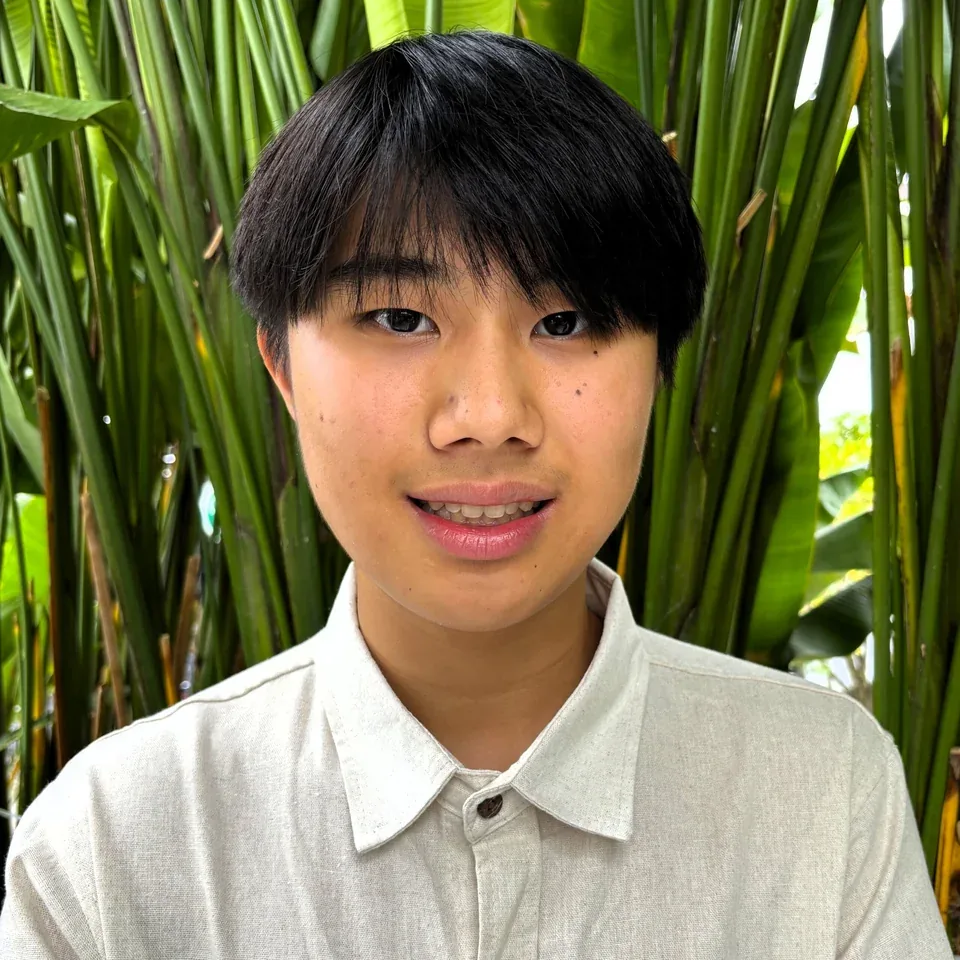
Bob’s Year 10 selfie in his school uniform
50th in
James Ruse Science
Bob in Year 12 wearing his James Ruse school jacket
1st in
Ruse Physics

Physics state rank99.85 ATARUSYD Med

دروس HSC في الفيزياء والكيمياء والرياضيات.

شاهد درسًا تجريبيًا مدته 10 دقائق

نجاح طلابنا

القصة كاملةالقصة كاملة

القصة وراء Tutorgum.

قبل أن أتصدر الفيزياء في James Ruse، لم أكن أريد حتى أن أخبر أمي بنتائجي.

صورة Bob الشخصية بزي المدرسة في الصف العاشر
المركز 50 في علوم James Ruse
Bob مرتديًا سترة James Ruse في الصف الثاني عشر
الأول في فيزياء James Ruse

المركز الأول على الولاية في الفيزياءATAR 99.85الطب في جامعة سيدني

Skip story

قبل أن أحقق المركز الأول في فيزياء James Ruse،لم أكن أجرؤ حتى على إخبار أمي بدرجاتي.

قبل أن أحقق المركز الأول في فيزياء James Ruse،
لم أكن أجرؤ حتى على إخبار أمي بدرجاتي.

كنت في الصف العاشر.

يا للأسف.

لكن كان هناك شيء أسوأ لدي من التقاط صور السيلفي.

العلوم.

لم تكن نتائجي جيدة.

تبًّا.
المركز 50 في الصف.

كرهت العلوم.

درست. حفظت. وتدرّبت.

ومع ذلك استخدمت الصيغ الخاطئة.
واضطررت إلى التخمين في الامتحانات.

لم أستطع الوصول إلى المراكز الأولى أو تجاوز 90%.

فقدت السيطرة.

لم أرد إخبار أمي بدرجاتي.

لذلك عرفت أن شيئًا ما يجب أن يتغير.

ثم حققت

  1. الأول في فيزياء James Ruse.
  2. المركز الأول على الولاية في الفيزياء.
  3. ATAR 99.85.
  4. طب جامعة سيدني.
شرح واضح من البداية وبطريقة بديهية.

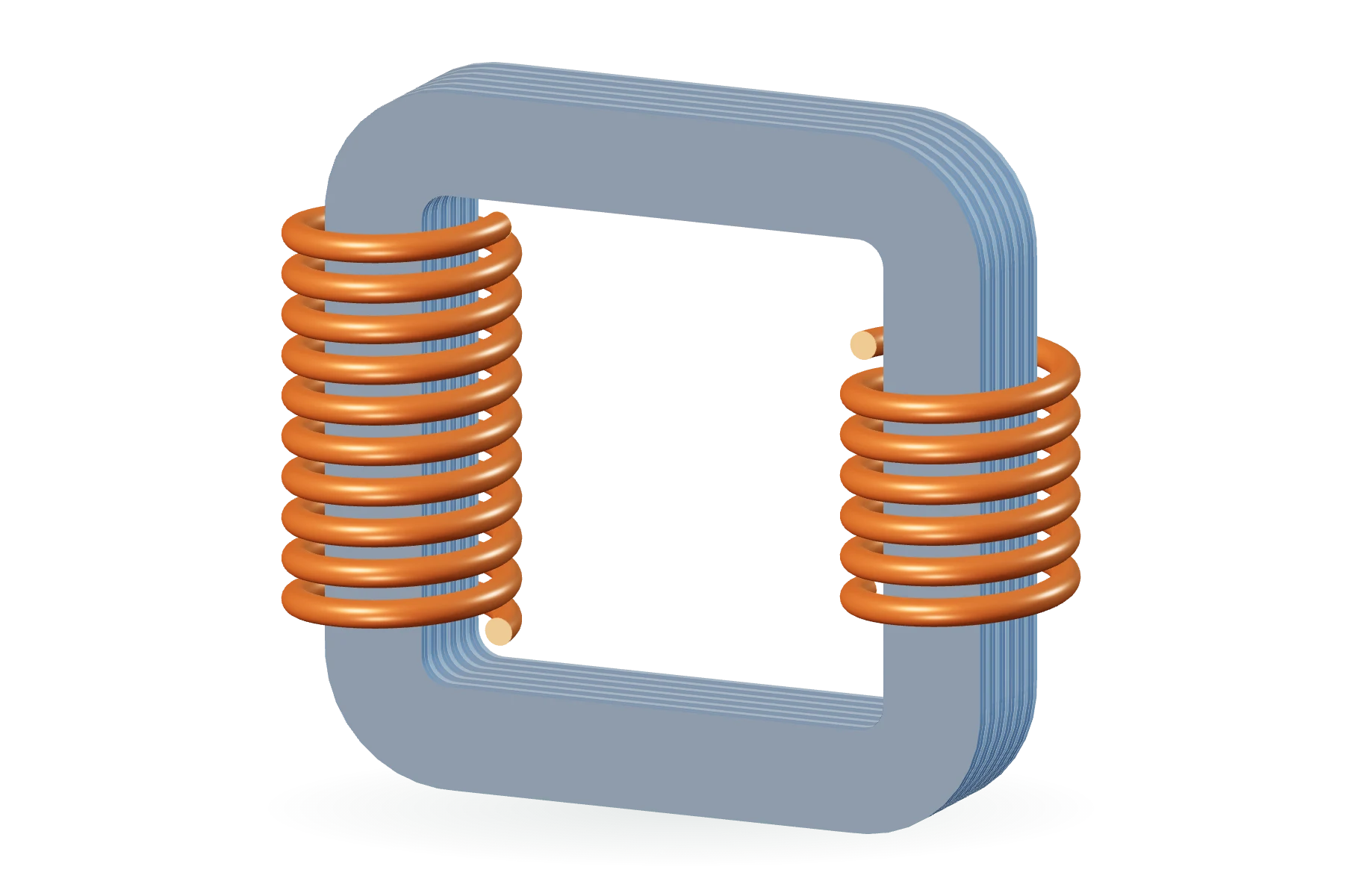
ملفّان نحاسيان حول قلب حديدي مكوّن من صفائح. يخلق التيار المتغيّر في الملف الأول مجالًا مغناطيسيًا متغيّرًا، فيُحدِث جهدًا في الملف الثاني.

نتعلم جميعًا عن المحوّلات، لكن هل تساءلت يومًا عن سبب تصميم كل جزء بهذه الطريقة؟

لنعد إلى الأساسيات: ملفّان من الأسلاك فقط.

يمر تيار في السلك فينشأ حوله مجال مغناطيسي.

نلف السلك فنحصل على ملف لولبي يولّد مجالًا مغناطيسيًا.

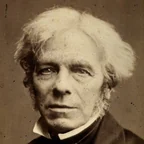
يُحدِث المجال المتغيّر للملف الأيسر جهدًا في الملف الأيمن. هذا هوقانون فاراداي.صورة لمايكل فاراداي

تستخدم الشواحن اللاسلكية هذا التصميم ذي القلب الهوائي. ويمكننا جعله أكفأ!

نضيف قلبًا من الحديد الطري، فهو يعزّز المجال المغناطيسي في الملف الأيسر.

الفكرة الذكية هي تمديد الحديد إلى الملف الأيمن. هكذا يصل مزيد من المجال إلى الملف ويتغيّر الفيض فيه أكثر.

نغلق الحلقة الحديدية لنمنح المجال مسارًا للعودة.

تقلّل صفائح الحديد المعزولة التيارات الدوامية والحرارة. هذا هو المحوّل كاملًا!

2.واجبات بأسلوب الامتحان

تعرف كيف تتعلم في المدرسة
…

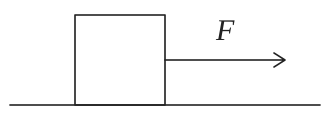
جسم على سطح أفقي تؤثر فيه قوة أفقية واحدة F.F

لكن في الامتحان،
قد تواجه…
But then, in the exam, قد تواجه…

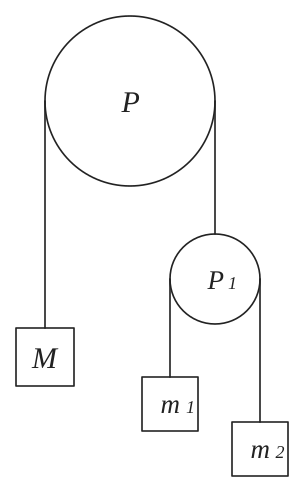
ثلاث كتل موصولة ببكرتين: تتدلى الكتلة M من البكرة الكبيرة P التي تحمل بكرة أصغر P₁ عليها الكتلتان m₁ وm₂.PP1Mm1m2

ماذا لو حللت أسئلة كهذه في واجبك كل أسبوع؟

فيزياء Year 12 · المنعطفات المائلة

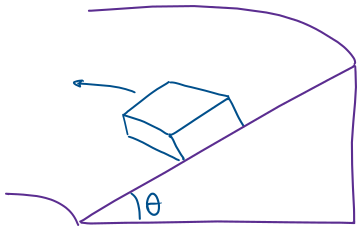
منعطف نصف قطره 78 مترًا مائل بزاوية 10 درجات. معامل الاحتكاك 0.1.

  1. ما السرعة المثالية التي تسير بها السيارة بحيث لا تحتاج إلى استخدام الاحتكاك؟
  2. ما أقل سرعة لاجتياز هذا المنعطف؟
  3. لنفترض الآن أن معامل الاحتكاك 0.3. ما نطاق السرعات التي يمكن للسيارة أن تجتاز بها المنعطف؟ فسّر سبب ظهور السرعة سالبة.

ولكل سؤال حلٌّ مشروح خطوة بخطوة.

وسّع الكلعرض أقل

a) ما السرعة المثالية التي تسير بها السيارة بحيث لا تحتاج إلى استخدام الاحتكاك؟

ANSWER

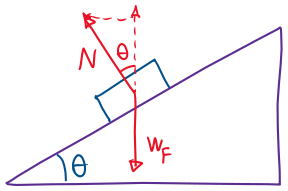
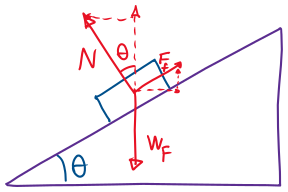
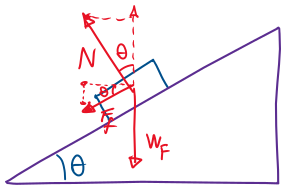
Step 1: Force diagram
Step 2: Force analysis

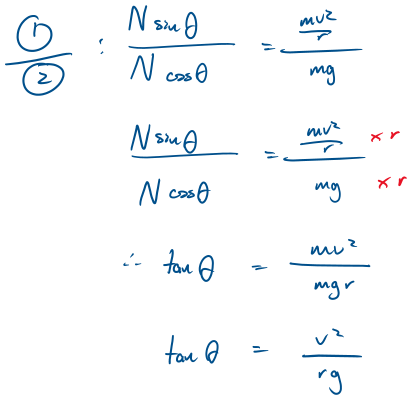
Considering the x – there is a net force! The horizontal part of tension must be the centripetal force!

Considering the y – there is no net force. Thus the vertical part of tension must balance the weight force

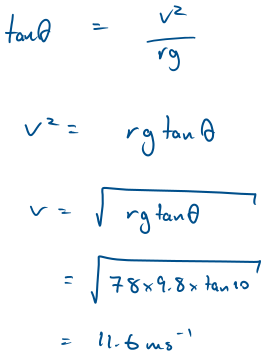
Step 3: Set up equation
Step 4: Plug and chug

b) ما أقل سرعة لاجتياز هذا المنعطف؟

ANSWER

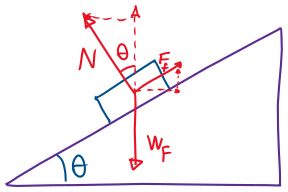
Step 1: Draw force diagram

The force of friction must point up the slope. When the car goes really slow, the car will slip towards the centre.

Step 2: Write out force equations

Vertically:

Ncos⁡θ+Ffsin⁡θ=Wf(1)N\cos \theta +{F}_{f}\sin \theta ={W}_{f}\quad (1)

Horizontally:

FC=Nsin⁡θ−Ffcos⁡θ(2){F}_{C}=N\sin \theta -{F}_{f}\cos \theta \quad (2)

If we transform them:

FC=−Ffcos⁡θ+Nsin⁡θ(2)′{F}_{C}=-{F}_{f}\cos \theta +N\sin \theta \quad {(2)}^{'}
Wf=Ff+sin⁡θ+Ncos⁡θ(1)′{W}_{f}={F}_{f}+\sin \theta +N\cos \theta \quad {(1)}^{'}
Step 3: Maths
(2)′(1)′FCWf=−Ffcos⁡θ+Nsin⁡θFf+sin⁡θ+Ncos⁡θ\frac{{(2)}^{'}}{{(1)}^{'}} \frac{{F}_{C}}{{W}_{f}}=\frac{-{F}_{f}\cos \theta +N\sin \theta }{{F}_{f}+\sin \theta +N\cos \theta }
mv2rmg=−μNcos⁡θ+Nsin⁡θμN+sin⁡θ+Ncos⁡θ\frac{\frac{m{v}^{2}}{r}}{mg}=\frac{-\mu N\cos \theta +N\sin \theta }{\mu N+\sin \theta +N\cos \theta }
v2rg=−μcos⁡θ+sin⁡θμsin⁡θ+cos⁡θ\frac{\frac{{v}^{2}}{r}}{g}=\frac{-\mu \cos \theta +\sin \theta }{\mu \sin \theta +\cos \theta }
v2=−0.1cos⁡10+sin⁡100.1sin⁡10+cos⁡10×78×9.8{v}^{2}=\frac{-0.1\cos 10+\sin 10}{0.1\sin 10+\cos 10}\times 78\times 9.8
v=7.6ms−1v=7.6 {ms}^{-1}

c) لنفترض الآن أن معامل الاحتكاك 0.3. ما نطاق السرعات التي يمكن للسيارة أن تجتاز بها المنعطف؟ فسّر سبب ظهور السرعة سالبة.

ANSWER

If you do the calculations, you’ll see that the min speed is negative!

What does this mean!?

It means there is no minimum speed. At any speed the friction will prevent you from sliding down. You could be going at 0m/s and you’ll be able to stay on the curve (there’s just a lot of friction!). it’s like how you can stand on a slanted hill surface.

Step 1: Force equations

Vertically:

Ncos⁡θ+Ffsin⁡θ=Wf(1)N\cos \theta +{F}_{f}\sin \theta ={W}_{f}\quad (1)

Horizontally:

Fc=Nsin⁡θ−Ffcos⁡θ(2){F}_{c}=N\sin \theta -{F}_{f}\cos \theta \quad (2)

At maximum friction:

Ff=μN{F}_{f}=\mu N
Step 2: Maths

Dividing (2) by (1):

FcWf=−μNcos⁡θ+Nsin⁡θμNsin⁡θ+Ncos⁡θ\frac{{F}_{c}}{{W}_{f}}=\frac{-\mu N\cos \theta +N\sin \theta }{\mu N\sin \theta +N\cos \theta }
mv2/rmg=−μcos⁡θ+sin⁡θμsin⁡θ+cos⁡θ\frac{m{v}^{2}/r}{mg}=\frac{-\mu \cos \theta +\sin \theta }{\mu \sin \theta +\cos \theta }
v2rg=−0.3cos⁡10+sin⁡100.3sin⁡10+cos⁡10\frac{{v}^{2}}{rg}=\frac{-0.3\cos 10+\sin 10}{0.3\sin 10+\cos 10}
v2=−89.8{v}^{2}=-89.8

Since v2{v}^{2} cannot be negative, there is no minimum speed.

Step 3: Maximum speed

Friction now acts down the slope, as the car tends to slide up the slope.

Vertically:

Ncos⁡θ−Ffsin⁡θ=Wf(1)N\cos \theta -{F}_{f}\sin \theta ={W}_{f}\quad (1)

Horizontally:

Fc=Nsin⁡θ+Ffcos⁡θ(2){F}_{c}=N\sin \theta +{F}_{f}\cos \theta \quad (2)

Using Ff=μN{F}_{f}=\mu N, divide (2) by (1):

FcWf=μNcos⁡θ+Nsin⁡θNcos⁡θ−μNsin⁡θ\frac{{F}_{c}}{{W}_{f}}=\frac{\mu N\cos \theta +N\sin \theta }{N\cos \theta -\mu N\sin \theta }
v2rg=μcos⁡θ+sin⁡θcos⁡θ−μsin⁡θ\frac{{v}^{2}}{rg}=\frac{\mu \cos \theta +\sin \theta }{\cos \theta -\mu \sin \theta }

Substitute:

v2=78(9.8)(0.3cos⁡10+sin⁡10cos⁡10−0.3sin⁡10){v}^{2}=78(9.8)(\frac{0.3\cos 10+\sin 10}{\cos 10-0.3\sin 10})
v=384.4v=\sqrt{384.4}
v=19.6m/sv=19.6 m/s

Hence the range of speeds is

0≤v≤19.6m/s0\leq v\leq 19.6 m/s

And don’t worry,
there’s plenty more where that came from.

3.دعم فردي من المدرّس

اسأل في أي وقت أثناء الحصة أو بعدها أو بين الحصص، وتواصل مع مدرّسك متى احتجت.

لا نقدّم دروسًا خاصة منفردة.

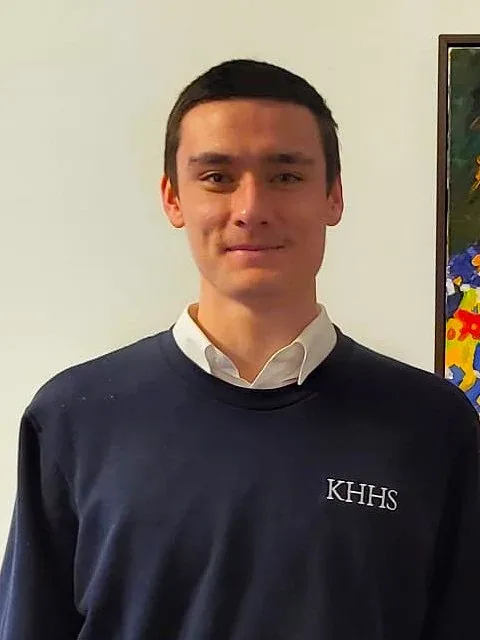
Bob Chen
7thترتيب ولاية نيو ساوث ويلز في الفيزياء
Jerome Shin
100%امتحان الرياضيات الموسّعة 1 · James Ruse

كيف يبدو أسبوعك فعلًا مع Tutorgum؟

تنتهي الحصة، ويستمر التعلّم.

الاثنين
الثلاثاء
الأربعاء
الخميس
الجمعة
السبت
الأحد
الحصة7–9pm
الواجبتدرّب على أسئلة بنمط الامتحان مع حلول مفصّلة لمساعدتك.
دعم المدرّساسأل فور ظهور السؤال. لا داعي للانتظار حتى الحصة المقبلة.
ابحث عن حصتك

الاثنين 7–9pm

01 / 06
  1. اختبار قصير

  2. مراجعة

  3. شرح

  4. أسئلة

  5. شرح

  6. أسئلة

مسار دورة الفيزياء
وحدةً بعد وحدة.

عرض الفصول الدراسيةإخفاء الفصول الدراسية
تستمر الحصص خلال العطلات المدرسيةاستراحة أسبوعين في عيد الميلاد ورأس السنة
الوحدة 1: Fundamentals of mechanicsMotion, forces, energy and momentum — الخطة الأسبوعيةتستمر الحصص خلال عطلة الفصل الدراسي الثاني

يبدأ ترقيم الأسابيع من 1 في كل وحدة. الموضوعات الأسبوعية مأخوذة من خطتنا الحالية وتُراجع وفق المنهج الجديد.

  1. الأسبوع 1
    Vectors and motion

    Distinguish scalars and vectors, then connect displacement, speed and velocity to everyday motion.

  2. الأسبوع 2
    Motion graphs and relative velocity

    Interpret displacement, velocity and acceleration graphs and describe motion from another observer's perspective.

  3. الأسبوع 3
    SUVAT and free fall

    Apply constant-acceleration equations to harder motion problems, including objects moving under gravity.

  4. الأسبوع 4
    Adding vectors

    Add and subtract vectors, resolve perpendicular components and solve motion problems in two dimensions.

  5. الأسبوع 5
    Motion practice and a first look at forces

    Practise vector and motion questions, then introduce forces as the next step in explaining motion.

  6. الأسبوع 6
    Forces and free-body diagrams

    Review Newton's laws, identify the forces on an object and build useful free-body diagrams.

  7. الأسبوع 7
    Friction, tension and net force

    Work through friction and tension questions and combine forces to find the net force.

  8. الأسبوع 8
    Inclined planes and connected systems

    Resolve forces on slopes, include drag and analyse objects connected as a system.

  9. الأسبوع 9
    Work and energy

    Define work as energy transfer by a force and apply it to force and displacement questions.

  10. الأسبوع 10
    Power and gravitational potential energy

    Connect force, velocity and power, then examine changes in gravitational potential energy.

  11. تستمر الحصص خلال عطلة الفصل الدراسي الثاني
  12. الأسبوع 11
    Conservation of mechanical energy

    Choose a convenient zero for potential energy and solve harder gravitational and kinetic energy problems.

  13. الأسبوع 12
    Momentum and collisions

    Introduce momentum and use collision examples to predict how interacting objects move.

  14. الأسبوع 13
    Conservation of momentum

    Analyse collisions, objects sticking together and explosions; compare momentum and kinetic energy.

  15. الأسبوع 14
    Collisions in two dimensions وDynamics consolidation

    Resolve momentum in perpendicular directions and practise angled collisions and module questions. Revisit the module's harder questions and consolidate the final Dynamics practice.

الوحدة 2: WavesWave properties, sound and light — الخطة الأسبوعيةتستمر الحصص خلال عطلة الفصل الدراسي الثالث

يبدأ ترقيم الأسابيع من 1 في كل وحدة. الموضوعات الأسبوعية مأخوذة من خطتنا الحالية وتُراجع وفق المنهج الجديد.

  1. الأسبوع 1
    Wave models and wave graphs

    Compare wave types, read displacement graphs and connect wave motion to energy transfer.

  2. الأسبوع 2
    Huygens' model and wave behaviour

    Explore longitudinal waves and use wavefronts to explain reflection and diffraction.

  3. الأسبوع 3
    Sound and resonance

    Connect natural frequency and resonance to sound, pitch and the inverse-square relationship.

  4. الأسبوع 4
    Standing waves

    Explain sound interference and resonance, then construct standing waves in strings and pipes.

  5. الأسبوع 5
    Refraction and Snell's law

    Explain refraction using changes in wave speed, then apply refractive index, Snell's law and dispersion.

  6. الأسبوع 6
    Total internal reflection and ray diagrams

    Use the critical angle to explain total internal reflection and practise ray diagrams and image formation.

  7. الأسبوع 7
    Lenses and image formation

    Compare converging and diverging lenses, trace images and revisit the earlier wave topics.

  8. الأسبوع 8
    Temperature, heat and internal energy

    Distinguish temperature, heat and internal energy; apply calorimetry and examine phase changes.

  9. تستمر الحصص خلال عطلة الفصل الدراسي الثالث
  10. الأسبوع 9
    Thermal transfer

    Explain conduction, convection and radiation and apply thermal conductivity to heat-transfer questions.

  11. الأسبوع 10
    Lesson focus to be confirmed وWaves and thermodynamics revision

    Ask your tutor which topics this class will cover. Consolidate the module through revision and practice questions.

الوحدة 3: Electricity and magnetismCharges, circuits and magnetic fields — الخطة الأسبوعيةتستمر الحصص خلال عطلة الفصل الدراسي الرابع

يبدأ ترقيم الأسابيع من 1 في كل وحدة. الموضوعات الأسبوعية مأخوذة من خطتنا الحالية وتُراجع وفق المنهج الجديد.

  1. الأسبوع 1
    Charge and Coulomb's law

    Describe electric charge, compare charging methods and calculate forces between charges.

  2. الأسبوع 2
    Electric fields and voltage

    Draw electric fields and connect field strength, force and electric potential difference.

  3. الأسبوع 3
    Uniform fields and electric energy

    Compare uniform and non-uniform fields, examine fringe effects and use work and equipotential ideas.

  4. الأسبوع 4
    Current, resistance and circuits

    Introduce current and resistance, apply Ohm's law and compare electrical power, AC and DC.

  5. الأسبوع 5
    Series circuits and electrical models

    Explain current and voltage in circuits and calculate equivalent resistance and voltage drops.

  6. الأسبوع 6
    Kirchhoff's laws

    Apply the junction and loop rules to determine currents and voltages in circuits.

  7. الأسبوع 7
    Magnetic fields

    Explore magnetic poles, Earth's field and the rules for drawing magnetic field lines.

  8. الأسبوع 8
    Fields around wires and solenoids

    Use moving charges to explain magnetic fields around current-carrying wires, loops and solenoids.

  9. تستمر الحصص خلال عطلة الفصل الدراسي الرابع
  10. الأسبوع 9
    Magnetic forces

    Use right-hand rules and force equations for moving charges and current-carrying conductors.

  11. الأسبوع 10
    Electricity and magnetism revision

    Review charging, fields, circuits, Kirchhoff's laws and magnetic-force directions.

Prelim prepModule review and preliminary exam practice — الخطة الأسبوعية

يبدأ ترقيم الأسابيع من 1 في كل وحدة.

  1. الأسبوع 1
    Kinematics review وDynamics review وWaves and thermodynamics review وElectricity and magnetism review

    Revisit SUVAT, motion problem-solving strategies and common limiting cases. Review work, energy and momentum, including elastic and inelastic collisions. Revise wave classifications, propagation and graphs through exam-style questions. Review charging and electrical concepts alongside feedback on the preceding module paper.

  2. الأسبوع 2
    Preliminary mock paper 1 وPreliminary mock paper 2 وPreliminary mock paper 3

    Practise mixed preliminary questions, including river-boat motion and momentum. Work through a second mock paper with attention to connected-system reasoning. Practise the latest third preliminary mock paper and review your working.

الوحدة 5: Advanced MechanicsProjectiles, circular motion and gravity — الخطة الأسبوعية

يبدأ ترقيم الأسابيع من 1 في كل وحدة.

  1. الأسبوع 1
    Projectile motion

    Revise kinematics and vector resolution, then analyse projectiles launched at an angle.

  2. الأسبوع 2
    Harder projectile problems

    Build a systematic approach to horizontal and vertical motion, including hidden information and unknowns.

  3. الأسبوع 3
    Circular motion

    Connect period, speed and centripetal acceleration and distinguish centripetal and centrifugal descriptions.

  4. الأسبوع 4
    Forces in circular motion

    Use friction, tension and banked-track examples to identify the inward force.

  5. الأسبوع 5
    Non-uniform circular motion

    Analyse banked tracks with friction and explore the changing forces in vertical circular motion.

  6. الأسبوع 6
    Circular motion and energy

    Apply radial and tangential reasoning and energy ideas to roller-coaster and circular-motion questions.

  7. الأسبوع 7
    Orbits and Kepler's laws

    Combine gravitation and centripetal force to find orbital speed and interpret Kepler's laws.

  8. الأسبوع 8
    Gravitational potential energy

    Use an infinity reference for gravitational potential energy and compare it with near-Earth approximations.

  9. الأسبوع 9
    Orbital transfers and mechanics review

    Explore Newton's cannon and orbital transfers, then revisit challenging projectile and circular-motion questions.

  10. الأسبوع 10
    Advanced Mechanics exam practice

    Work through the latest Module 5 exam and consolidate the module's problem-solving techniques.

عطلة عيد الميلاد ورأس السنةإجازة لمدة 2 أسابيع
الوحدة 6: ElectromagnetismFields, motors and induction — الخطة الأسبوعيةتستمر الحصص خلال العطلة الصيفية

يبدأ ترقيم الأسابيع من 1 في كل وحدة.

  1. تستمر الحصص خلال العطلة الصيفية
  2. الأسبوع 1
    Fields and the Lorentz force

    Review electric and magnetic fields and introduce forces on moving charges.

  3. الأسبوع 2
    Charged particles in fields

    Apply the Lorentz force to particle paths and harder electric and magnetic field questions.

  4. الأسبوع 3
    The motor effect

    Explain forces on current-carrying conductors and interactions between parallel wires.

  5. الأسبوع 4
    Magnetic flux and Faraday's law

    Define magnetic flux and use changing flux to explain induced electromotive force.

  6. الأسبوع 5
    Lenz's law and eddy currents

    Determine induced-current directions and explain applications of eddy currents.

  7. الأسبوع 6
    Transformers

    Connect induction to transformer operation, practical limitations and induction applications.

  8. الأسبوع 7
    DC motors

    Revise torque and explain how coils, brushes and commutators make a DC motor work.

  9. الأسبوع 8
    Motor applications and back EMF

    Compare motor arrangements and explain the role of back EMF in operation.

  10. الأسبوع 9
    Generators and back torque

    Explain generator operation and the opposing torque associated with electromagnetic induction.

  11. الأسبوع 10
    AC induction motors and braking

    Explore induction motors, three-phase arrangements and electromagnetic braking.

  12. الأسبوع 11
    Electromagnetism exam practice

    Practise exam-style electromagnetic questions and review the module's key ideas.

الوحدة 7: The Nature of LightWaves, photons and relativity — الخطة الأسبوعيةتستمر الحصص خلال عطلة الفصل الدراسي الثاني

يبدأ ترقيم الأسابيع من 1 في كل وحدة.

  1. الأسبوع 1
    Maxwell, Hertz and light

    Trace the development and verification of the electromagnetic model of light.

  2. الأسبوع 2
    Measuring light and reading spectra

    Compare measurements of the speed of light and introduce spectra as evidence about stars.

  3. الأسبوع 3
    Wave and particle models

    Compare Newton and Huygens, then examine Young's double-slit and Poisson-spot evidence.

  4. تستمر الحصص خلال عطلة الفصل الدراسي الثاني
  5. الأسبوع 4
    Diffraction and polarisation

    Apply diffraction-grating relationships and Malus' law and compare evidence for light models.

  6. الأسبوع 5
    Blackbody radiation

    Explore the ultraviolet catastrophe and how blackbody radiation challenged classical physics.

  7. الأسبوع 6
    The photoelectric effect

    Compare classical predictions with observations and use the photon model to explain the effect.

  8. الأسبوع 7
    Special relativity

    Introduce time dilation, length contraction and simultaneity through thought experiments and paradoxes.

  9. الأسبوع 8
    Evidence for relativity

    Examine experiments supporting relativity's postulates, time dilation and length contraction.

  10. الأسبوع 9
    Relativistic momentum and energy

    Apply relativistic momentum, mass-energy relationships and velocity addition.

  11. الأسبوع 10
    Explaining changes in light models

    Construct extended responses connecting experimental evidence to the development of light models.

الوحدة 8: From the Universe to the AtomStars, atoms and nuclei — الخطة الأسبوعيةتستمر الحصص خلال عطلة الفصل الدراسي الثالث

يبدأ ترقيم الأسابيع من 1 في كل وحدة.

  1. الأسبوع 1
    The Big Bang and expanding universe

    Explore the Big Bang model, expanding space and the formation of cosmic structures.

  2. الأسبوع 2
    Stars and nucleosynthesis

    Connect stellar spectra, the Hertzsprung-Russell diagram and nuclear reactions in stars.

  3. الأسبوع 3
    Discovering the electron

    Compare cathode-ray experiments, charge-to-mass measurements and Millikan's oil-drop experiment.

  4. الأسبوع 4
    The nucleus and neutron

    Use scattering evidence to explain Rutherford's model and examine Chadwick's neutron discovery.

  5. الأسبوع 5
    Hydrogen spectra and Bohr's model

    Connect hydrogen emission lines and the Rydberg relationship to Bohr's atomic model.

  6. الأسبوع 6
    Matter waves and quantum models

    Explore the limits of Bohr's model, de Broglie's proposal and the development of quantum descriptions.

  7. تستمر الحصص خلال عطلة الفصل الدراسي الثالث
  8. الأسبوع 7
    Radioactivity and half-life

    Compare radiation types, calculate radioactive decay and examine nuclear instability.

  9. الأسبوع 8
    Fission, fusion and binding energy

    Connect binding energy to nuclear reactions, reactors and energy release.

  10. الأسبوع 9
    The Standard Model

    Examine evidence for subatomic structure and organise fundamental particles using the Standard Model.

  11. الأسبوع 10
    Particle accelerators

    Explain how accelerators probe matter and contribute to developing particle models.

Trials preparationReview the topics and practise trial questions — الخطة الأسبوعية

يبدأ ترقيم الأسابيع من 1 في كل وحدة.

  1. الأسبوع 1
    Advanced Mechanics revision

    Revisit Module 5 theory and practise questions chosen around areas needing revision.

  2. الأسبوع 2
    Electromagnetism revision

    Review forces on charges, helical motion and induction through challenging Module 6 questions.

  3. الأسبوع 3
    The Nature of Light revision

    Practise questions on light measurements, wave evidence, photons and relativity.

  4. الأسبوع 4
    Universe to Atom revision

    Review cosmology, stellar reactions, atomic models and quantum evidence.

  5. الأسبوع 5
    Trial mock paper 1

    Work through mixed questions on mechanics, motors, transformers and scientific reasoning.

  6. الأسبوع 6
    Trial mock paper 2

    Practise mixed questions involving induction, photoelectric observations, light models and relativity.

  7. الأسبوع 7
    Trial mock paper 3

    Work through the third mock-paper stage and revisit the mechanics questions selected in the notes.

HSC exam preparationTimed papers, difficult questions and exam technique — الخطة الأسبوعيةتستمر الحصص خلال عطلة الفصل الدراسي الرابع

يبدأ ترقيم الأسابيع من 1 في كل وحدة.

  1. الأسبوع 1
    Advanced Mechanics exam consolidation

    Practise circular motion, banked tracks and gravitational-energy questions.

  2. تستمر الحصص خلال عطلة الفصل الدراسي الرابع
  3. الأسبوع 2
    Induction and back-EMF practice

    Develop explanations and solve harder induction and motor questions.

  4. الأسبوع 3
    Light and photon exam consolidation

    Review Planck's proposal and the photoelectric effect, with emphasis on conceptual responses.

  5. الأسبوع 4
    Mass-defect practice

    Explain mass defect and practise the related calculations.

  6. الأسبوع 5
    Relativity and response review

    Revisit proper time and proper length and review selected written responses.

  7. الأسبوع 6
    Mixed exam-question review

    Work through the selected exam questions and refine your problem-solving approach.

  8. الأسبوع 7
    Physics exam technique

    Practise flux, binding-energy and radiation questions alongside time management and response planning.

  9. الأسبوع 8
    Challenging HSC questions

    Combine mechanics, induction, relativity, spectra and scientific skills in harder exam problems.

  10. الأسبوع 9
    Final HSC paper practice

    Work through the final HSC practice paper and review questions needing further attention.

أسعار دروس الفيزياء

اطّلع على رسوم الحصص الأسبوعية ضمن مجموعات صغيرة، وما تتضمنه، واختر الوقت المناسب لك.

الصف 10/11 الفيزياء

$55/ الساعة

110 دولار أسترالي أسبوعيًا

  • تشمل حصة مدتها ساعتان
  • واجبات مع حلول مفصّلة خطوة بخطوة لكل سؤال
  • مساعدة في أي أسئلة إضافية لديك
  • الاستعداد للامتحانات ومشروعات الدراسة المتعمقة
ابحث عن حصة للصف 10/11

الصف 12 الفيزياء

$60/ الساعة

120 دولار أسترالي أسبوعيًا

  • تشمل حصة مدتها ساعتان
  • واجبات مع حلول مفصّلة خطوة بخطوة لكل سؤال
  • مساعدة في أي أسئلة إضافية لديك
  • الاستعداد للامتحانات ومشروعات الدراسة المتعمقة
ابحث عن حصة للصف 12

تختلف أوقات الحصص حسب المجموعة. استخدم عوامل التصفية أدناه لمعرفة الحصص المتاحة حاليًا.

الجداول الدراسية

اعثر على حصتك.

لماذا لا تجرّب حصة؟ من دون مخاطرة!

تُحتسب رسوم الحصة الأولى فقط إذا رغبت في المتابعة؛ وإلا فهي مجانية تمامًا.

الأسئلة الشائعة

هل تقدمون دروس فيزياء عبر الإنترنت لطلاب سيدني وخارجها؟

نعم. تُعقد دروس HSC Physics عبر Zoom، ويمكن لطلاب سيدني ومناطق نيو ساوث ويلز وغيرها في أستراليا الانضمام. تشمل مجموعات الصفين 11 و12 واجبات بأسلوب الامتحان وحلولًا مشروحة ودعمًا فرديًا من المدرس. يتبع المنهج HSC في نيو ساوث ويلز؛ تواصل معنا للتحقق من ملاءمته إذا كنت تدرس منهجًا آخر.

هل يمكنني الانضمام بعد بدء الدورة؟

أخبرنا بصفك والموضوعات التي درستها وما تجد صعوبة فيه. سنساعدك على اختيار مجموعة مناسبة ونناقش ما تحتاج إلى تعويضه قبل التسجيل.

ماذا لو كانت مدرستي تدرس الموضوعات بترتيب مختلف؟

تتبع دورتنا تسلسلًا محددًا. أحضر جدول تقييمات مدرستك لنقارنه بخطة الدروس ونناقش دعم الموضوعات التي تحتاج إليها مبكرًا.

هل أختار المسار المتسارع أم العادي؟

يبدأ المسار المتسارع في الصف 10، الفصل الرابع، الأسبوع الأول. ويبدأ المسار العادي في الصف 11، الفصل الأول، الأسبوع الأول. يتبع كلاهما تسلسل الوحدات نفسه. أخبرنا بصفك وخبرتك في الفيزياء لنساعدك على الاختيار.

ماذا لو كنت مترددًا في طرح الأسئلة؟

يمكنك السؤال أثناء الحصة أو التحدث مع مدرسك على انفراد. الدعم الفردي يساعدك على فهم سؤال أو فكرة لم تتضح بعد.

What happens when I book a trial?

Send us your year, subject and preferred class. We’ll help you find a suitable lesson. The first lesson is only charged if you want to continue, otherwise it's totally free!

طفلي خجول جدًا ولا يجرؤ على السؤال. هل تناسبه الدروس الجماعية؟

كنت طفلًا خجولًا مثله. كنت أخشى طرح الأسئلة لأنني كنت أقلق مما قد يفكّر فيه الآخرون.

  • يمكن للطلاب طرح أسئلتهم على انفراد بعد الحصّة، أو إرسالها بالبريد الإلكتروني أو الرسائل النصية بين الحصص.
  • أطرح أسئلة على كل طالب أثناء الحصّة ليشارك الجميع.
  • أتابع تقدّم كل طالب لألاحظ ما إذا كان يواجه صعوبة في مجاراة المجموعة.

إذا كنت تحتاج حتمًا إلى دروس فردية طوال الوقت، فأنصحك بالبحث عن مدرّس آخر.

لكن ما الأهم لك، شكل الدرس أم أن يتعلّم طفلك على يد خبير؟ المدرّسون كثيرون، لكن كم منهم كان من الأوائل في نيو ساوث ويلز؟ ليسوا جميعًا على دراية مثلي بالتوازن الكيميائي والكهرومغناطيسية، أو بكيفية شرحها حتى تتّضح للطالب، أو بأسباب فقدان الدرجات وكيفية معالجتها. ولهذا قد لا يحقّقون نتيجة كتلك التي حقّقتها Kirsten Chu عام 2022 حين ارتفعت درجتها من 56% إلى 91%.

هل يستطيع طفلي مجاراة المجموعة؟

لا أحد يرغب في أن يتأخّر كثيرًا عن زملائه. لمساعدتك على تحديد مدى ملاءمة الدروس، يبدأ طلابنا عادةً بدرجات متوسّطة أو أقلّ قليلًا من المتوسّط. نستقبل طلابًا من مدارس انتقائية مثل NSB وNSG وRuse، ومدارس خاصّة مثل Scots وSt Patricks وMeriden، ومدارس غير انتقائية مثل Castle Hill وCarlingford HS. نساعدهم على اللحاق بالمجموعة بالإجابة عن أسئلتهم بعد الدرس وتوفير مواد عن المواضيع السابقة.

وعندما نشرح موضوعًا جديدًا نبدأ دائمًا من الأساس، حتّى إن فات الطالب بعض المفاهيم السابقة.

ماذا لو كانت لدى طفلي أسئلة؟

ندير مجموعتنا بطريقة مختلفة عن معظم المدرّسين. يسعدني تخصيص وقت فردي للطالب. يمكنه سؤالي على انفراد بعد الحصّة وفي أي وقت خلال الأسبوع. ويمكنني أن أخصّص له ساعة عند الحاجة.

كيف تُقدَّم الدروس؟

نعقد حصّة واحدة مدّتها ساعتان كل أسبوع، عبر الإنترنت على Zoom.

ماذا تفعلون في الحصّة؟

نبدأ باختبار قصير مدّته عشر دقائق. ثم نشرح مفهومًا جديدًا ونحلّ بعض الأسئلة لتثبيته، ونكرّر ذلك طوال الحصّة. وعند اقتراب الامتحانات نعقد حصص مراجعة، فنرسل امتحانًا تدريبيًا قبل الحصّة ونناقش فيها الأسئلة الصعبة التي يطلب الطلاب شرحها.

كيف يتمّ الدفع؟

نقبل التحويل المصرفي ونصدر الفاتورة عادةً لكل فصل دراسي. إذا رغبت في التوقّف عن الدراسة، نردّ إليك كامل قيمة الحصص التي لم تستخدمها.

ماذا لو تغيّبت عن حصّة؟

ننصحك بشدّة بألّا تتغيّب بسبب الامتحانات. إن ضاق وقتك، فمن الأفضل تأجيل الواجب وحضور الحصّة. إذا تغيّبت، نرسل لك كل المواد ونسجّل الحصّة لك، لكن رسوم تلك الحصّة لا تُردّ.

هل لديكم مواعيد أخرى؟

اطّلع على جدول الدروس لمعرفة المواعيد المتاحة.

هل تستمرّ الدروس في العطلات؟

نعم، تستمرّ الدروس كالمعتاد خلال العطلات المدرسية. ولا نقدّم حصصًا مكثّفة في العطلات لأنّها لا تفيد الطلاب على النحو المطلوب.

كم طالبًا في المجموعة؟

يختلف العدد من مجموعة إلى أخرى، لكنه غالبًا نحو خمسة طلاب.

ما الذي يحتاج إليه الطلاب للدراسة عبر الإنترنت؟

الحماس وقلم، ويُفضّل أيضًا دفتر مخصّص للدروس. نرسل إليك جميع المواد الأخرى.

كيف تهيّئون الطلاب لامتحانات المدرسة؟

السبب الرئيسي وراء ضعف النتائج هو عدم إتقان المفاهيم الأساسية. بعد دراسة المحتوى معنا، تزول هذه المشكلة لدى معظم الطلاب. وبعد ترسيخ الأساس، نقدّم كل أسبوع واجبات بأسلوب أسئلة الامتحان ليتدرّب الطلاب باستمرار.

وقبيل الامتحانات نتيح للطلاب استخدام مجموعتنا الخاصّة من أوراق امتحانات المدارس السابقة، وهي من أفضل وسائل التدريب. ونشرح أيضًا أساليب التعامل مع الامتحان أثناء الحصص.

متى تنتهون من المنهج؟

في الدروس المتسارعة ننهي عادةً المنهج كاملًا قبل امتحانات الصف الثاني عشر التجريبية بفصل دراسي واحد. تُعقد تلك الامتحانات في الأسبوع الثاني من الفصل الثالث، فيتوفّر نحو سبعة أسابيع للمراجعة قبلها، ثم نحو عشرة أسابيع بعدها للتحضير لامتحانات HSC. نراجع كل وحدة باختبار أسبوعي عنها، ثم نحلّ امتحانات محاكية.

وفي الفصول التي تتبع وتيرة المدرسة نساير تقدّمها، ويكون لدينا نحو ستّة أسابيع لمراجعة HSC.

بأي ترتيب تدرّسون وحدات المنهج؟

نُدرّس الوحدات بالترتيب من 1 إلى 8.

ماذا لو كان ترتيب المواضيع في مدرستي مختلفًا؟

تختار بعض المدارس ترتيبًا مختلفًا. ومن واقع خبرتي، هذا لا يسبّب مشكلة، لأننا نغطّي المحتوى نفسه بحلول موعد الامتحان. الأهم أن يتعلّم الطالب، سواء تزامنت الدروس مع ترتيب المدرسة أم لا.

ما المستوى المعتاد لطلابكم؟

يبدأ طلابنا عادةً بدرجات متوسّطة أو أقلّ منها قليلًا. ونستقبل طلابًا من مدارس انتقائية مثل NSB وNSG وRuse، ومدارس خاصّة مثل Scots وSt Patricks وMeriden، ومدارس غير انتقائية مثل Castle Hill وCarlingford HS.

لأيّ طالب يناسب برنامجكم؟

تحسّن مستواك لا يتوقّف على ذكائك. أهمّ عامل للنجاح في البرنامج هو استعدادك لبذل الجهد. طلاب مثل Jade Yang وKirsten Chu شهدوا تحسّنًا ملحوظًا وخصّصوا أكثر من عشر ساعات أسبوعيًا للفيزياء والكيمياء. نسهّل عليك العمل، فإذا أنجزت جميع الواجبات، وهي تدريب للامتحانات، وحضرت كل حصّة، فسوف تتحسّن.

السؤال هو: هل ستلتزم بذلك؟

هل تقدّمون دروسًا في الفيزياء والكيمياء عبر الإنترنت؟

نعم. نقدّم الفيزياء والكيمياء في مجموعات صغيرة لطلاب الصفّين الحادي عشر والثاني عشر الذين يدرسون منهج HSC في نيو ساوث ويلز. يُختصر اسم الفيزياء أحيانًا إلى phys، وهي المادة نفسها. تُعقد الدروس عبر Zoom، وتشمل واجبات بأسلوب الامتحان وحلولًا مفصّلة ودعمًا فرديًا بين الحصص.

اطّلع على دروس الفيزياء أو دروس الكيمياء أو تحقّق من الأسعار ومواعيد الدروس.

هل يمكن الانضمام من سيدني أو مناطق نيو ساوث ويلز الأخرى أو من خارج الولاية؟

نعم. تُعقد الدروس عبر الإنترنت، لذا يمكنك الانضمام من سيدني أو نيوكاسل أو ولونغونغ أو أي منطقة أخرى في نيو ساوث ويلز أو في أستراليا. لا داعي للذهاب إلى مركز للتقوية.

صُمّمت الفيزياء والكيمياء وفق منهج HSC في نيو ساوث ويلز. إذا كنت تدرس منهج ولاية أخرى أو منهجًا مختلفًا، تواصل معنا واذكر صفّك والمواضيع التي تدرسها لنناقش مدى ملاءمة الدروس لك. إتاحة الدروس عبر الإنترنت لا تعني أنها تغطّي جميع المناهج.

هل لديك سؤال آخر؟

اتّصل على 0490 496 078